
All posts by jbeecherblog

Our 2025 reading list

On this page you will find a list of titles of the books we will read and discuss in 2025. When we have full details for events – date and venue for discussion, free resources and more, there will be a link to a separate page on this site for each event.

We provide this list in advance of full details so that people can plan and budget ahead, perhaps picking a few books from the year they would most like to focus on, or times when they are most able to find time to read. If you can find the time to read all the books and join us for all the discussions, that’s wonderful – but we are more than happy to welcome people along to a single session on a topic they are most interested in.

We are very grateful that, once again, most if not all of the books will be available to buy from the Yellow Lighted Bookshop with a 15% discount – as the books up till April already are (by entering the coupon code “25stroudradical” when you reach the basket stage).

Our discussions will always be held in a Stroud town centre location, and entry will always be free – with occasional collections of donations to cover costs.

2025 book list:

January: The Life and Rhymes of Benjamin Zephaniah by Benjamin Zephaniah (our webpage with full details)

February: Safety Through Solidarity: A Radical Guide to Fighting Antisemitism by Shane Burley and Ben Lorber (our webpage with full details)

March / International Womens’ Day: Revolutionary and Enemy Feminisms: Revolutionary Feminisms – Conversations on Collective Action and Radical Thought by Brenna Bhandar and Rafeef Ziadah (Editors) and Enemy Feminisms: TERFs, Policewomen, and Girlbosses Against Liberation by Sophie Lewis (our webpage)

April: Climate in Parable of The Sower by Octavia Butler and It’s Not That Radical by Mikaela Loach (our webpage)

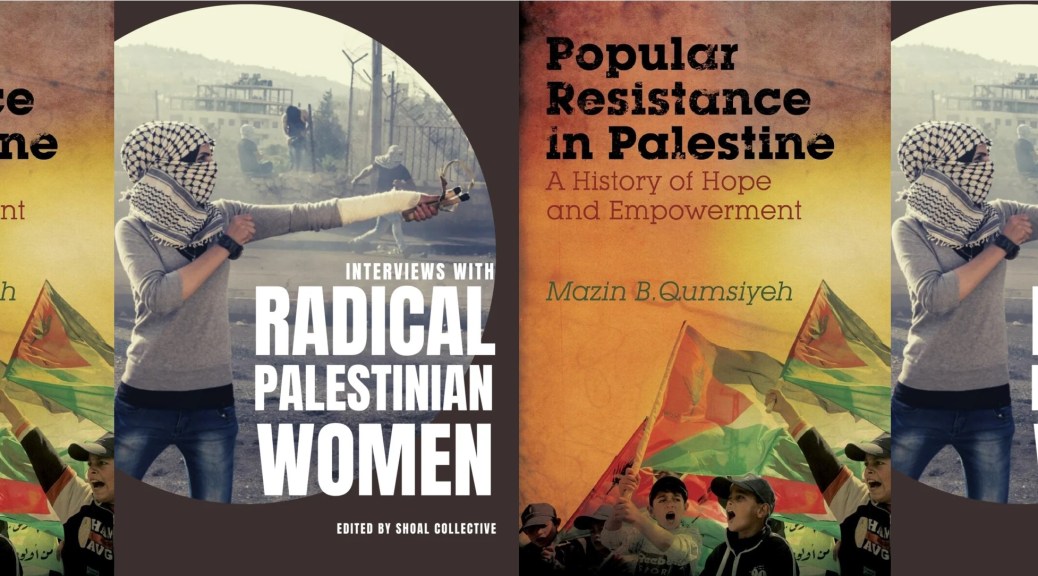
May: Radicalism and Resistance in Palestine: Popular Resistance in Palestine: A History of Hope and Empowerment by Mazin B. Qumsiyeh and Interviews with Radical Palestinian Women by Shoal Collective (our webpage)

June: Black on Both Sides: A Racial History of Trans Identity by C.Riley Snorton (our webpage)

July: Syria Speaks: Art and Culture from the Frontline – Edited by Malu Halasa, Zaher Omareen, Nawara Mahfoud (our webpage)

August: Toussaint Louverture The Story of the Only Successful Slave Revolt in History By C.L.R. James – Graphic Novel Adaptation by Nic Watts and Sakina Karimjee (our webpage)

September: Burnout: The Emotional Experience of Political Defeat by Hannah Proctor (Yellow Lighted Bookshop shop page)

October: Wayward Lives, Beautiful Experiments – Intimate Histories of Riotous Black Girls, Troublesome Women and Queer Radicals, by Saidiya Hartman (Yellow Lighted Bookshop shop page)

November: Lipstick Traces: A secret history of the twentieth century by Griel Marcus (Yellow Lighted Bookshop shop page)

December: Encounters With James Baldwin: Celebrating 100 Years – Edited by Kadija George Sesay and Cheryl Robson (Yellow Lighted Bookshop shop page)

Wednesday 19th February 2025- Safety Through Solidarity: A Radical Guide to Fighting Antisemitism

On Wednesday 19th February 2025, from 7.30-9.30pm, Stroud Radical Reading Group will host a discussion of “Safety Through Solidarity: A Radical Guide to Fighting Antisemitism” by Shane Burley and Ben Lorber. The event will be hosted jointly by Stroud Radical Reading Group and Na’amod Gloucestershire. Na’amod is “a movement of Jews in the UK seeking to end our community’s support for Israel’s occupation and apartheid, and to mobilise it in the struggle for freedom, equality and justice for all Palestinians and Israelis”, and a Gloucestershire branch was formed in 2024.

Entry is free and everyone is welcome.

PLEASE NOTE DIFFERENT VENUE FOR THIS EVENT: We will meet at The Exchange on Brick Row, GL5 1DF (a short walk from the town centre train or bus station, with parking available nearby at Church St).

More information about the book, venue and how sessions work is below – together with a link to buy the book at a discount and a variety of free text, audio, and visual resources relevant to the book/discussion.

About the book:

“From online trolling of Jews by the ‘alt-right’ to synagogue shootings by white nationalists to the spread of QAnon and George Soros conspiracy theories, antisemitism is a fixture of U.S. politics today. Its rise is part and parcel of growing exclusionary nationalist movements – putting multiracial democracy itself at risk. At the same time, conversations about antisemitism are more polarized than ever.

How is antisemitism connected to anti-Blackness, xenophobia, anti-LGBTQ bigotry, and other forms of oppression? How do we build the coalitions and movements we need to fight it all together? Why is it important to distinguish between legitimate criticism of Israel’s oppression of Palestinians and antisemitism?

Using personal stories, historical deep-dives, front-line reporting, and interviews with leading change-makers, Lorber and Burley help the reader understand how antisemitism works, what’s at stake in contemporary debates, and how we can build true safety in solidarity.”

This event follows the annual Holocaust Memorial Day, this year marking the 80th anniversary of the liberation of Auschwitz-Birkenau, the largest Nazi concentration camp complex (and the 30th anniversary of the genocide in Bosnia). In Stroud, Community Solidarity Stroud District hosted a local event on Sunday 26th January at the Lansdown Hall from 2-3pm.

Our 2025 event follows discussions of books linked to Holocaust Memorial Day in the past – Primo Levi’s The Drowned and The Saved, Revolutionary Yiddishland, and We Fight Fascists. Links to those previous events are provided for interest only – you do not have been to any of our previous events to come along to this one.

Resources

About our events and the venue

Stroud Radical Reading Group events are free to attend, though we will make a collection to cover venue hire costs – please bring some cash. We try to create a comfortable discussion space for everyone, including people who have not been part of a reading group or been to university. Anyone is welcome to listen to the discussion, though we encourage contributions only from those who have read at least some of the book we are discussing.

We will meet at The Exchange on Brick Row in Stroud. This is near the centre of town, a short walk from Stroud Railway Station or the Merrywalks Bus Station. There are stands to lock bikes to outside, and parking for cars nearby at Church St car park. There is sloped access to the building and to an accessible toilet. The room is well lit and warm. Please get in touch if you’d like to get more of an idea of what the sessions are like or if you have any accessibility needs.

January 15th 2025- The Life and Rhymes of Benjamin Zephaniah

On January 15th November 2025, from 7.30-9.30pm, Stroud Radical Reading Group will host a discussion of The Life and Rhymes of Benjamin Zephaniah. Entry is free and everyone is welcome. We will meet at 10 John St, GL5 2AH.

This event has been rescheduled from December – when it was cancelled due to unforeseen circumstances – many apologies. It was originally planned to mark the one year anniversary of Benjamin Zephaniah’s death – on the 7th December 2023.

On his own website, this is how the book is described: “Benjamin Zephaniah is old. So he decided to write his autobiography. It documents his life from the sound systems of Birmingham to the world stage.”

In the early 1980s when punks and Rastas were on the streets protesting about unemployment, homelessness and the National Front, Benjamin’s poetry could be heard at demonstrations, outside police stations and on the dance floor. His mission was to take poetry everywhere, and to popularise it by reaching people who didn’t read books. His poetry was political, musical, radical and relevant.

The Lifes and Rhymes of is the stunning autobiography of the poet, writer, lyricist and activist, Benjamin Zephaniah.

This event follows our discussion of “Speak Out!” – an anthology of work by the Brixton Black Women’s Group in October, and Angela Davis’ autobiography – but you are welcome to attend this event alone, and do not have been to any of our previous events to come along to this one.

Resources

About our events and the venue

Stroud Radical Reading Group events are free to attend, though we will make a collection to cover costs – please bring some cash. We try to create a comfortable discussion space for everyone, including people who have not been part of a reading group or been to university. Anyone is welcome to listen to the discussion, though we encourage contributions only from those who have read at least some of the book we are discussing.

We will meet at 10 John St, GL5 2AH. This is near the centre of town, a short walk from Stroud Railway Station and a slightly longer walk from the Merrywalks Bus Station. There are stands to lock bikes to outside, and parking for cars nearby in either Brunel Mall, Fawkes Place, or Church St car park. There is a low step to enter the building, which is flat. There are no toilet facilities. Please get in touch if you’d like to get more of an idea of what the sessions are like or if you have any accessibility needs.

November 27th 2024 – An Autobiography by Angela Davis

On Wednesday 27th November 2024, from 7.30-9.30pm, Stroud Radical Reading Group will host a discussion of An Autobiography by Angela Davis. Entry is free and everyone is welcome. We will meet at 10 John St, GL5 2AH.

The book is a powerful and commanding account of the life of trailblazing political activist Angela Davis, detailing her journey from a childhood on Dynamite Hill in Birmingham, Alabama to one of the most significant political trials of the century. From her political activity in a New York high school to her work with the U.S. Communist Party, the Black Panther Party, and the Soledad Brothers; and from the faculty of the Philosophy Department at UCLA to the FBI’s list of the Ten Most Wanted Fugitives. Told with warmth, brilliance, humour and conviction, this autobiography is a classic account of a life in struggle with echoes in our own time.

Find links to buy the book and free resources related to it below, as well as information about the venue for our events and our group. If you do not have time to read the full book, we recommend focusing on Part 4 – Flames. Download part 4 here (this is still a big section, over 100 pages). We welcome contributions to the discussion from anyone who has engaged with any of the resources – even if they haven’t finished Part 4 or the book, and anyone to join us to listen in even if they have not been able to engage with any of the resources.

We’ll be following this event with a discussion on autobiography by Benjamin Zephaniah in December, and it follows our discussion of “Speak Out!” – an anthology of work by the Brixton Black Women’s Group in October – but you are welcome to attend this event alone, and do not have been to any of our previous events to come along to this one.

Resources

About our events and the venue

Stroud Radical Reading Group events are free to attend, though we will make a collection to cover costs – please bring some cash. We try to create a comfortable discussion space for everyone, including people who have not been part of a reading group or been to university. Anyone is welcome to listen to the discussion, though we encourage contributions only from those who have read at least some of the book we are discussing.

We will meet at 10 John St, GL5 2AH. This is near the centre of town, a short walk from Stroud Railway Station and a slightly longer walk from the Merrywalks Bus Station. There are stands to lock bikes to outside, and parking for cars nearby in either Brunel Mall, Fawkes Place, or Church St car park. There is a low step to enter the building, which is flat. There are no toilet facilities. Please get in touch if you’d like to get more of an idea of what the sessions are like or if you have any accessibility needs.

October 30th 2024 – Speak Out! The Brixton Black Women’s Group

On Wednesday 30th October 2024, from 7.30-9.30pm, Stroud Radical Reading Group will host a discussion of Speak Out, A Brixton Black Women’s Group Reader, edited by Milo Miller. Entry is free and everyone is welcome. We will meet at 10 John St, GL5 2AH. Find links to buy the book and free resources related to it below, as well as information about the venue for our events and our group.

The book brings together the writings of Brixton Black Women’s Group for the first time. Established in response to the lack of interest in women’s issues experienced in male-dominated Black organisations, the Brixton Black Women’s Group’s aim was to create a distinct space where women of African and Asian descent could meet to focus on political, social and cultural issues as they affected black women. BBWG published its own newsletter, Speak Out, which kept alive the debate about the relevance of feminism to black politics and provided a black women’s perspective on immigration, housing, health and culture.

We’ll be discussing the book in UK Black History Month, and following it with discussions on autobiographies by Angela Davis and Benjamin Zephaniah at our events in November and December, but you do not need to attend all three events or have been to any of our previous events to come along to this one.

Resources

About our events and the venue

Stroud Radical Reading Group events are free to attend, though we will make a collection to cover costs – please bring some cash. We try to create a comfortable discussion space for everyone, including people who have not been part of a reading group or been to university. Anyone is welcome to listen to the discussion, though we encourage contributions only from those who have read at least some of the book we are discussing.

We will meet at 10 John St, GL5 2AH. This is near the centre of town, a short walk from Stroud Railway Station and a slightly longer walk from the Merrywalks Bus Station. There are stands to lock bikes to outside, and parking for cars nearby in either Brunel Mall, Fawkes Place, or Church St car park. There is a low step to enter the building, which is flat. There are no toilet facilities. Please get in touch if you’d like to get more of an idea of what the sessions are like or if you have any accessibility needs.

Reviews

“For a new generation of feminist thinkers the relevance of this collection cannot be overstated. Intended for local distribution, the articles are a testament to the continuous theoretical study, fierce discipline, comradeliness and revolutionary love central to resistance against the most violent arms of the state…A balm, an instruction manual a historical object that defies temporality and a response to the forces that seek to depoliticise the history of racialised women’s struggle for freedom in Britain.

Lola Olufemi, author of Feminism Interrupted [which we discussed in 2021]

“An important testament to the pioneering Black British feminists of the 1970s and ’80s who set up groups and centres, and bravely and brilliantly campaigned against discrimination and for social change in the face of extreme opposition. Long ignored and undervalued, their grassroots activism adds unique and essential layers to the recorded histories of the era”

Bernardine Evaristo, author of Girl, Woman, Other

September 25th 2024 – Prima Facie & “What About The Rapists”

On Wednesday 25th September 2024, from 7.30-9.30pm, Stroud Radical Reading Group will host a discussion of Prima Facie, an award-winning play exploring the patriarchal power of the law through the experiences of a young, brilliant barrister who has worked her way up from working-class origins (links to watch or read the play below). Together with the play, we will discuss two short pieces from a zine called “What About The Rapists?”, which looks at contemporary anarchist theory and practice on crime and justice (links to download these below). Relevant to the issues raised by the play, these readings will also connect back to our previous two sessions (exploring anarchism in different ways), but you do not need to have attended the previous events to come along to this one.

Find links to resources related to the play and zine below, as well as information about the venue for our events and our group. We will meet at 10 John St, GL5 2AH.

Content warnings for sexual violence, rape specifically, and for the criminal justice system.

Resources

About our events and the venue

Stroud Radical Reading Group events are free to attend, though we will make a collection to cover costs – please bring some cash. We try to create a comfortable discussion space for everyone, including people who have not been part of a reading group or been to university. Anyone is welcome to listen to the discussion, though we encourage contributions only from those who have read at least some of the book we are discussing.

We will meet at 10 John St, GL5 2AH. This is near the centre of town, a short walk from Stroud Railway Station and a slightly longer walk from the Merrywalks Bus Station. There are stands to lock bikes to outside, and parking for cars nearby in either Brunel Mall, Fawkes Place, or Church St car park. There is a low step to enter the building, which is flat. There are no toilet facilities. Please get in touch if you’d like to get more of an idea of what the sessions are like or if you have any accessibility needs.

About the play

“Tessa is a young, brilliant barrister who has worked her way up from working-class origins to the top of her game: defending, cross-examining and winning. But when an unexpected event forces her to confront the patriarchal power of the law – where the burden of proof and morality diverge – she finds herself in a world where emotion and integrity are in conflict with the rules of the game.

After acclaimed productions in Australia and winning the Australian Writers’ Guild Award for Drama, Prima Facie received its European premiere in a sold-out run at the Harold Pinter Theatre in London’s West End in 2022 starring Jodie Comer in her West End debut. It was named Best New Play at both the 2023 Olivier and WhatsOnStage Awards. A filmed version, released in 2022, went on to become the highest-grossing event cinema release ever in the UK.”

About the zine

“This zine looks at contemporary anarchist theory and practice on
crime and justice, though it won’t be using these terms. The first half will be a critical examination of Transformative Justice-based
accountability processes, an approach with origins in US anarchist circles now taking seed in parts of Europe. The other half looks at retributive approaches, such as survivor-led direct action against rapists.”

August 28th 2024 – Anarcho-Indigenism: Conversations on Land and Freedom

On Wednesday 28th August 2024, from 7.30-9.30pm, Stroud Radical Reading Group will host a discussion of Anarcho-Indigenism: Conversations on Land and Freedom – edited by Edited by Francis Dupuis-Déri and Benjamin Pillet. We will meet at 10 John St, GL5 2AH. Below you can find links to free resources related to the book, to buy a physical copy of the book at a discount, information about the event and venue.

Anarcho-Indigenism is a dialogue between anarchism and indigenous politics. In their interviews, contributors Roxanne Dunbar-Ortiz, Véronique Hébert, Gord Hill, Freda Huson, J. Kēhaulani Kauanui, Clifton Ariwakehte Nicholas and Toghestiy reveal what indigenous thought and traditions and anarchism have in common, without denying the scars left by colonialism even within this anti-authoritarian movement. They ultimately offer a vision of the world that combines anti-colonialism, feminism, ecology, anti-capitalism and anti-statism.

You can buy the book from the Yellow Lighted Bookshop (Nailsworth, Tetbury or Chalford pick up or delivery at £3.50) via the previous link – RRP £14.99. When looking at your “basket” enter the “couponcode” stroudradical24 for a 12% discount – final book price £13.19, a saving of £1.80). The ebook is £9.99 from publishers Pluto Press.

Free resources

About our events and the venue

Stroud Radical Reading Group events are free to attend, though we will make a collection to cover costs – please bring some cash. We try to create a comfortable discussion space for everyone, including people who have not been part of a reading group or been to university. Anyone is welcome to listen to the discussion, though we encourage contributions only from those who have read at least some of the book we are discussing.

We will meet at 10 John St, GL5 2AH. This is near the centre of town, a short walk from Stroud Railway Station and a slightly longer walk from the Merrywalks Bus Station. There are stands to lock bikes to outside, and parking for cars nearby in either Brunel Mall, Fawkes Place, or Church St car park. There is a low step to enter the building, which is flat. There are no toilet facilities. Please get in touch if you’d like to get more of an idea of what the sessions are like or if you have any accessibility needs.

About the book, editors and contributors

“As early as the end of the 19th century, anarchists such as Peter Kropotkin and Élisée Reclus became interested in indigenous peoples, many of whom they saw as societies without a state or private property, living a form of communism. Contemporary thinkers such as David Graeber and John Holloway have continued this tradition of engagement with the practices of indigenous societies and their politics, while indigenous activists and intellectuals coined the term ‘anarcho-indigenism’, in reference to a long history of (often imperfect) collaboration between anarchists and indigenous activists, over land rights and environmental issues, including recent high profile anti-pipeline campaigns.”

Publishers description (Pluto Press)

Francis Dupuis-Déri is a Professor of Political Science and a member of the Institut de Recherches et d’études Féministes at the Université du Québec à Montréal.

Benjamin Pillet is a translator and community organizer.

Gord Hill is an Indigenous writer, artist and activist from the Kwakwaka’wakw nation.

Roxanne Dunbar-Ortiz is Professor Emerita of Ethnic Studies at California State University. She is author of An Indigenous Peoples’ History of the United States.

Clifton Ariwakehte Nicholas is a Kanienkeha’ka activist, film-maker and entrepreneur from Kanesatake. He made a number of independent documentaries such as ‘Elsipogtog: No Fracking Way!‘ and ‘Karistatsi Onienre: The Iron Snake‘ on the pipeline project called Énergie Est (embedded below)

Véronique Hébert is an actor, theatre director and writer from the Atikamekw First Nation of Wemotaci.

Freda Huson is a Wet’suwet’en land defender and representative of the Wet’suwet’en Camp in North West British Columbia, blocking various tar sands and fracked gas pipelines.

Toghestiy is a Wet’suwet’en land defender and representative of the Wet’suwet’en Camp in North West British Columbia blocking various tar sands and fracked gas pipelines. Toghestiy is a hereditary chief of the Likhts’amisyu Clan.

J. Kēhaulani Kauanui is a diasporic Kanaka Maoli (Native Hawaiian) born in southern California on traditional homeland of the Tongva people. She is the co-producer for Anarchy on Air, a majority POC radio show co-produced with a group of students.

Longer biographies are available on the Pluto Press website, or via the links above)

July 31st 2024: Means and Ends – The Revolutionary Practice of Anarchism in Europe and the United States

On Wednesday 31st July 2024, from 7.30-9.30pm, Stroud Radical Reading Group will host a discussion of Means and Ends: The Revolutionary Practice of Anarchism in Europe and the United States by Zoe Baker. We will meet at 10 John St, GL5 2AH. Below you can find links to free resources related to the book, to buy a physical copy of the book at a discount, information about the event and venue.

Means and Ends is a new overview of the revolutionary strategy of anarchism in Europe and the United States between 1868 and 1939. Zoe Baker clearly and accessibly explains the ideas that historical anarchists developed in order to change the world. This includes their views on direct action, revolution, organization, state socialism, reforms, and trade unions. The consistent heart of anarchism was the idea that anarchist ends can only be achieved through anarchist means. Baker draws upon a vast assortment of examples to show how this simple premise underpinned anarchist attempts to put theory into action.

You can buy the book from the Yellow Lighted Bookshop (Nailsworth, Tetbury or Chalford pick up or delivery at £3.50) via the previous link – RRP £21. When looking at your “basket” enter the “couponcode” stroudradical24 for a 12% discount – final book price £18.48, a saving of £2.52).

About our events and the venue

Stroud Radical Reading Group events are free to attend, though we will make a collection to cover costs – please bring some cash. We try to create a comfortable discussion space for everyone, including people who have not been part of a reading group or been to university. Anyone is welcome to listen to the discussion, though we encourage contributions only from those who have read at least some of the book we are discussing.

We will meet at 10 John St, GL5 2AH. This is near the centre of town, a short walk from Stroud Railway Station and a slightly longer walk from the Merrywalks Bus Station. There are stands to lock bikes to outside, and parking for cars nearby in either Brunel Mall, Fawkes Place, or Church St car park. There is a low step to enter the building, which is flat. There are no toilet facilities. Please get in touch if you’d like to get more of an idea of what the sessions are like or if you have any accessibility needs.

About the book and author

Means and Ends is a new overview of the revolutionary strategy of anarchism in Europe and the United States between 1868 and 1939. Zoe Baker clearly and accessibly explains the ideas that historical anarchists developed in order to change the world. This includes their views on direct action, revolution, organization, state socialism, reforms, and trade unions.
Throughout, she demonstrates that the reasons anarchists gave for supporting or opposing particular strategies were grounded in a theoretical framework—a theory of practice—which maintained that, as people engage in activity, they simultaneously change the world and themselves. This theoretical framework was the foundation for the anarchist commitment to the unity of means and ends: the means that revolutionaries propose to achieve social change have to involve forms of activity which transform people into individuals who are capable of, and driven to, both overthrow capitalism and the state and build a free society. The consistent heart of anarchism was the idea that anarchist ends can only be achieved through anarchist means. Cutting through misconceptions and historical inaccuracies, Baker draws upon a vast assortment of examples to show how this simple premise underpinned anarchist attempts to put theory into action.”

Publishers description (Pluto Press)

Zoe Baker is a libertarian socialist philosopher with a PhD on the history of anarchism. She is known for popularizing the theory and history of anarchism, feminism, and Marxism on her popular YouTube and Twitter platforms

Free resources:

June 26th 2024: Burning Country – Syrians in Revolution and War

On Wednesday 26th June 2024, from 7.30-9.30pm, Stroud Radical Reading Group will host a discussion of Burning Country: Syrians in Revolution and War by Robin Yassin-Kassab and Leila Al-Shami. We will meet at 10 John St, GL5 2AH. Below you can find links to a free copy of the book as a pdf, to buy a physical copy of the book at a discount, information about the event, venue and free resources.

In 2011, many Syrians took to the streets of Damascus to demand the overthrow of the government of Bashar al-Assad. Burning Country explores the horrific and complicated reality of life in present-day Syria.

You can buy the book from the Yellow Lighted Bookshop (Nailsworth, Tetbury or Chalford pick up or delivery at £3.50) via the previous link – RRP £14.99. When looking at your “basket” enter the “couponcode” stroudradical24 for a 12% discount – final book price £13.19, a saving of £1.80).

Event format

We are very fortunate that one of the authors, Robin Yassin-Kassab, is hoping to join us half way through the meeting to answer questions about the book. We will also be joined by Rami, a Syrian refugee living locally.

About our events and the venue

Stroud Radical Reading Group events are free to attend, though we will make a collection to cover costs – please bring some cash. Anyone is welcome to listen to the discussion, though we encourage contributions only from those who have read at least some of the book we are discussing. We try to create a comfortable discussion space for everyone, including people who have not been part of a reading group or been to university.

We will meet at 10 John St, GL5 2AH. This is near the centre of town, a short walk from Stroud Railway Station and a slightly longer walk from the Merrywalks Bus Station. There are stands to lock bikes to outside, and parking for cars nearby in either Brunel Mall, Fawkes Place, or Church St car park. There is a low step to enter the building, which is flat. There are no toilet facilities. Please get in touch if you’d like to get more of an idea of what the sessions are like or if you have any accessibility needs.

About the book and authors

“Burning Country explores the horrific and complicated reality of life in present-day Syria with unprecedented detail and sophistication, drawing on new first hand testimonies from opposition fighters, exiles lost in an archipelago of refugee camps, and courageous human rights activists among many others. These stories are expertly interwoven with a trenchant analysis of the brutalisation of the conflict and the militarisation of the uprising, of the rise of the Islamists and sectarian warfare, and the role of governments in Syria and elsewhere in exacerbating those violent processes. With chapters focusing on ISIS and Islamism, regional geopolitics, the new grassroots revolutionary organisations, and the worst refugee crisis since World War Two, Burning Country is a vivid and groundbreaking look at a modern-day political and humanitarian nightmare.”

Publishers description (Pluto Press)

Robin Yassin-Kassab is a regular media commentator on Syria and the Middle East. He is the author of the novel The Road from Damascus (Penguin, 2009) and contributor to Syria Speaks (Saqi, 2014).

Leila Al-Shami has worked with the human rights movement in Syria and across in the Middle East. She is a founding member of Tahrir-ICN, a network that aimed to connect anti-authoritarian struggles across the Middle East, North Africa and Europe.

Free resources:

May 29th 2024: Pedagogy of the Oppressed, by Paulo Freire

On Wednesday 29th May 2024, from 7.30-9.30pm, Stroud Radical Reading Group will host a discussion of Pedagogy of the Oppressed. We will meet at 10 John St, GL5 2AH. Below you can find links to a free copy of the book as a pdf, to buy a physical copy of the book at a discount, information about the event, venue and more. We’ll be looking at three quotes in particular, discussing them in small groups. If you don’t have time to read the full book, we recommend Chapter 2 (pages 71-86).

This book argues that the perceived passivity of the poor is the direct result of economic, social and political domination. It suggests that in some countries the oppressors use the ‘piggy bank’ system – treating students as passive, empty vessels – to preserve their authority and maintain a culture of silence. Through cooperation and dialogue, Freire suggests, the authoritarian teacher-pupil model can be replaced with critical thinking so that the student becomes co-creator of knowledge. Crucial to Freire’s argument is the belief that every human being, no matter how impoverished or illiterate, can develop an awareness of self, and the right to be heard.

You can buy the book from the Yellow Lighted Bookshop (Nailsworth, Tetbury or Chalford pick up or delivery at £3.50) via the previous link – RRP £9.99. When looking at your “basket” enter the “couponcode” stroudradical24 for a 12% discount – final book price £8.79, a saving of £1.20).

Event format

At this event we’ll focus on three quotes – which you can read below. We’ll discuss these in small groups before coming together as a single group at the end of the meeting to share reflections that have come up through those discussions or from reading parts of the book we haven’t been able to discuss. We’ll start the session with an invitation to share brief personal thoughts on our own experiences of education.

The three quotes – which can be read in context from the full book available free as a pdf (from libcom.org) are:

  1. From Chapter 2 (page 73) “This solution is not (nor can it be) found in the banking concept.
    On the contrary, banking education maintains and even stimulates the contradiction through the following attitudes and practices, which mirror oppressive society as a whole:
    (a) the teacher teaches and the students are taught;
    (b) the teacher knows everything and the students know nothing;
    (c) the teacher thinks and the students are thought about;
    (d) the teacher talks and the students listen—meekly;
    (e) the teacher disciplines and the students are disciplined;
    (f) the teacher chooses and enforces his choice, and the students comply;
    (g) the teacher acts and the students have the illusion of acting through the action of the teacher;
    (h) the teacher chooses the program content, and the students (who were not consulted) adapt to it;
    (i) the teacher confuses the authority of knowledge with his or her own professional authority, which she and he sets in opposition to the freedom of the students;
    (j) the teacher is the Subject of the learning process, while the pupils are mere objects.
    It is not surprising that the banking concept of education regards men as adaptable, manageable beings. The more students work at storing the deposits entrusted to them, the less they develop the critical consciousness which would result from their intervention in the world as transformers of that world. The more completely they accept the passive role imposed on them, the more they tend simply to adapt to the world as it is and to the fragmented view of reality deposited in them.”
  2. From Chapter 4 (page 149): “In the words of Francisco Weffert:
    All the policies of the Left are based on the masses and depend on the consciousness of the latter. If that consciousness is confused, the Left will lose its roots and certain downfall will be imminent, although (as in the Brazilian case) the Left may be deluded into thinking it can achieve the revolution by means of a quick return to power.
    In a situation of manipulation, the Left is almost always tempted by a “quick return to power,” forgets the necessity of joining with the oppressed to forge an organization, and strays into an impossible “dialogue” with the dominant elites. It ends by being manipulated by these elites, and not infrequently itself falls into an elitist game, which it calls “realism.”
    Manipulation, like the conquest whose objectives it serves, attempts to anesthetize the people so they will not think. For if the people join to their presence in the historical process critical thinking about that process, the threat of their emergence materializes in revolution. Whether one calls this correct thinking “revolutionary consciousness” or “class consciousness,” it is an indispensable precondition of revolution. The dominant elites are so well aware of this fact that they instinctively use all means, including physical violence, to keep the people from thinking. They have a shrewd intuition of the ability of dialogue to develop a capacity for criticism.”
  3. From Chapter 4 (page 128): “Dialogue with the people is radically necessary to every authentic revolution. This is what makes it a revolution, as distinguished from a military coup. One does not expect dialogue from a coup—only deceit (in order to achieve “legitimacy”) or force (in order to repress).
    Sooner or later, a true revolution must initiate a courageous dialogue with the people. Its very legitimacy lies in that dialogue. It cannot fear the people, their expression, their effective participation in power. It must be accountable to them, must speak frankly to them of its achievements, its mistakes, its miscalculations, and its difficulties.
    The earlier dialogue begins, the more truly revolutionary will the movement be. The dialogue which is radically necessary to revolution corresponds to another radical need: that of women and men as beings who cannot be truly human apart from communication, for they are essentially communicative creatures. To impede com munication is to reduce men to the status of “things”—and this is a job for oppressors, not for revolutionaries.
    Let me emphasize that my defense of the praxis implies no dichotomy by which this praxis could be divided into a prior stage of reflection and a subsequent stage of action. Action and reflection occur simultaneously.”

About our events and the venue

Stroud Radical Reading Group events are free to attend, though we will make a collection to cover costs – please bring some cash. Anyone is welcome to listen to the discussion, though we encourage contributions only from those who have read at least some of the book we are discussing. We try to create a comfortable discussion space for everyone, including people who have not been part of a reading group or been to university.

We will meet at 10 John St, GL5 2AH. This is near the centre of town, a short walk from Stroud Railway Station and a slightly longer walk from the Merrywalks Bus Station. There are stands to lock bikes to outside, and parking for cars nearby in either Brunel Mall, Fawkes Place, or Church St car park. There is a low step to enter the building, which is flat. There are no toilet facilities. Please get in touch if you’d like to get more of an idea of what the sessions are like or if you have any accessibility needs.

About the book and author

Paulo Reglus Neves Freire (19 September 1921 – 2 May 1997) was a Brazilian educator and philosopher who was a leading advocate of critical pedagogy. His influential work Pedagogy of the Oppressed is generally considered one of the foundational texts of the critical pedagogy movement, and was the third most cited book in the social sciences as of 2016 according to Google Scholar. Freire joined the Workers’ Party (PT) in São Paulo and acted as a supervisor for its adult literacy project from 1980 to 1986. When the Workers’ Party won the 1988 São Paulo mayoral elections in 1988, Freire was appointed municipal Secretary of Education.

Freire wrote Pedagogy of the Oppressed between 1967 and 1968, while living in the United States. Originally written in his native Portuguese, Pedagogy of the Oppressed was first published in Spanish in 1968

Due to the 1964 Brazilian coup d’état, where a military dictatorship was put in place with the support of the United States, Paulo Freire was exiled from his home country, an exile that lasted 16 years. After a brief stay in Bolivia, he moved to Chile in November 1964 and stayed until April 1969 when he accepted a temporary position at Harvard University. His four-and-a-half year stay in Chile impacted him intellectually, pedagogically, and ideologically, and contributed significantly to the theory and analysis he presents in Pedagogy of the Oppressed. In Freire’s own words:

When I wrote [Pedagogy of the Oppressed] I was already completely convinced of the problem of social classes. In addition, I wrote this book on the basis of my extensive experience with peasants in Chile; being absolutely convinced of the process of ideological hegemony and what that meant. When I would hear the peasants speaking, I experienced the whole problem of the mechanism of domination (which I analyze in the first chapter of the book)…Certainly, in my earliest writings I did not make this explicit, because I did not perceive it yet as such…[Pedagogy of the Oppressed] is also completely situated in a historical reality.

Free resources: