This is an online event, which will be held from 7.30-9.30pm on Wednesday 27th January, via Zoom. For Zoom details, which we keep private to group members, please contact us.
27 January marks the anniversary of the liberation of Auschwitz-Birkenau, the largest Nazi death camp. Holocaust Memorial Day (HMD) is held each year on this date. The theme for HMD 2021is “Be the light in the darkness” and it encourages everyone to take action to ‘be the light’.
We will discuss “Silent Starry Night” – Chapter 4 of Alain Brossat and Sylvia Klingberg’s Revolutionary Yiddishland. The chapter addresses “the image of the Jew in the face of Nazism that history has retained”, one “not that of the Resistance fighter but that of the victim”. It asks, and answers the following questions:Was there really a Jewish Resistance? How was the action of the Yiddishland revolutionaries continued – or interrupted – by the war? Did the figure of the Jewish combatant acquire a sufficient profile to stand against that of the victim and martyr who accepts his lot as the blow of fate?
Find out more about Revolutionary Yiddishland at the Verso website, where you can buy the full text at £6.99 paperbook+ebook (30% off at the moment). You can download chapter 4 via the link below, but you are encouraged to read more of the book if you are able.
(B)ordering Britain argues that Britain is the spoils of empire, its immigration law is colonial violence and irregular immigration is anti-colonial resistance. The British Empire, about which Britons know little, can be remembered fondly as a moment of past glory, as a gift once given to the world. Meanwhile immigration laws are justified on the basis that they keep the undeserving hordes out.
Bordering Britain argues that – no matter what the law, media and political discourse dictate – people with personal, ancestral or geographical links to colonialism, or those existing under the weight of its legacy of race and racism, should have every right to come to Britain and take back what is theirs.
You will need to register for the event via Eventbrite in order to access details of the video calls (this is free, will prevent any ‘trolling’ of calls, and enable reminders).
As ever, Stroud Radical Reading Group events are free to attend. Please contact us about any accessibility requirements. We aim to make the sessions a welcoming space for anyone interested in the topics. You do not need to have a university education or have ever been to a reading group before, and we even welcome people who have not read the text but would like to listen to the discussion. Please contact us if you have any questions or would like to know more about how the sessions are run. If you are on Facebook, please also join our Facebook group.
On October 28th we will discuss “The Black Jacobins: Toussaint L’Ouverture and the San Domingo revolution” by C.L.R. James. The discussion will take place on a Zoom video call – please register (free) to access the details and be sent a reminder on the day.
In Black Jacobins, CLR James provides the definitive account of the Haitian Revolution of 1794-1803 and the story of the French colony of San Domingo. It is also the story of Toussaint L’Ouverture, who led the black people of San Domingo in a successful struggle against successive invasions by overwhelming French, Spanish, and English forces – helping to form the first independent nation in the Caribbean, and inspiring anti-colonial movements around the world.
The book obviously contains considerable references to the brutality of enslavement, and to racist ideas and commentary.
The full text of The Black Jacobins is available online for free in different formats. We encourage people to read the whole book, and as much as possible if not.
For those who know they will only have time for a section, our introducer Jeremy Green recommends Chapter 2 – The Owners. Click below to download Chaper 2 and introductory pages.
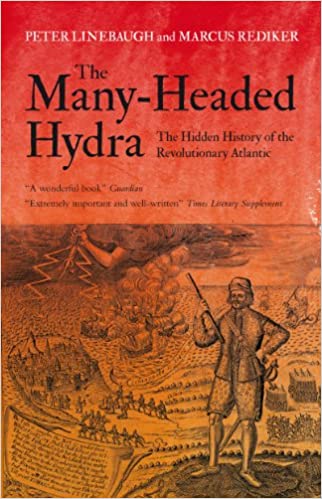
As part of our series of discussions exploring Geographies and Histories of Racial Capitalism (monthly online events till November 2020), on September 30th 2020 we discussed “The Many-Headed Hydra: Sailors, slaves, commoners, and the hidden history of the revolutionary Atlantic” by Peter Linebaugh and Marcus Rediker.
Marshaling an impressive range of original research from archives in the Americas and Europe, the authors of The Many Headed Hydra explore the foundations of our modern global economy, and show how ordinary working people led dozens of rebellions on both sides of the North Atlantic. The rulers of the day called the multiethnic rebels a ‘hydra’ and brutally suppressed their risings, yet some of their ideas fueled the age of revolution. Others, hidden from history and recovered here, have much to teach us about our common humanity.
Chapter 6 explores the the “structure of New York’s commerce”, at a time of slavery and imperialism – part of what the authors call their recovery of a “lost history of the multiethnic class that was essential to the rise of capitalism and the modern, global economy”. As Sukhdev Sandhu writes in his 2001 review of the book for The Guardian: “A central chapter of the book is concerned with what came to be known as the New York Conspiracy. In March 1741, radicals set fire to New York. Fort George, the prime military fortification in British America, was reduced to ashes. Soon, other metropolitan landmarks were torched. These were no random conflagrations. Lying on the west side of Manhattan, Fort George was a site of huge strategic importance for the Atlantic trade and a nodal point of the Britain-Africa-Americas triangle. Slaves and slave products were imported there. It was also populated by a swarm of people whose labours underwrote the city’s wealth, but who themselves were wholly despised.”
The chapter places the events of 1741 in context of a cycle of “multiracial conspiracies” and rebellions of the 1730s and 1740s, and notes how repression of these led to the promotion of “a white identity” in order to “produce new discipline and a different solidarity”.
Content warning: this chapter includes an image of a painting entitled “The hanging of an African in New York”. The book as a whole features other images of this nature, as well as some graphic descriptions of (racist and/or sexual) violence, and quotes historical racist texts.
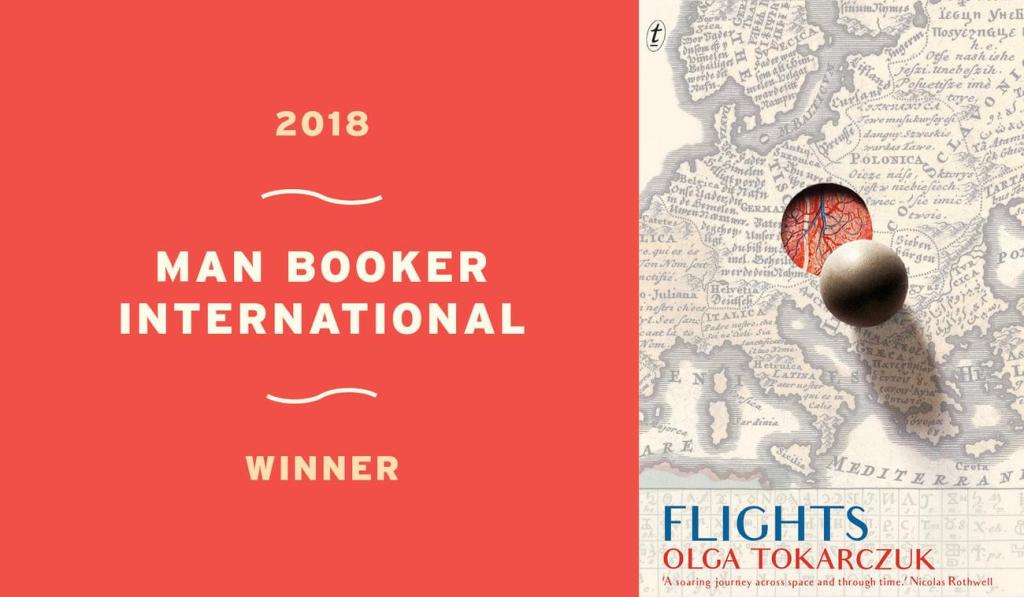
A member of our group, Dawid Majer, has selected Tokarczuk’s book Flights for us to read – and will introduce it. The book was originally published in Polish in 2007 – and, in English translation by Jennifer Croft, won the Man Booker International prize in 2018. For a brief introduction, this article covers Tokarczuk’s work. This article also covers the awarding of the 2019 Nobel prize for literature to Tokarczuk.
Another article covers Flights specifically, summarising: “In Flights, she meditates on travel and human anatomy, moving between stories including the Dutch anatomist who discovered the Achilles tendon when dissecting his own amputated leg, and the tale of Chopin’s heart as his sister transported it from Paris to Warsaw”.
Between July 29th and November 25th, Stroud Radical Reading Group will host a series of discussions exploring Racial Capitalism. Each of these events will be held on the last Wednesday of the month, 7.30-9.30pm – online via video call (we will continue to assess when it may be appropriate to host indoor events). You will need to register for the events via Eventbrite in order to access details of the video calls (this is free, will prevent any ‘trolling’ of calls, and enable reminders).
As ever, Stroud Radical Reading Group events are free to attend. Please contact us about any accessibility requirements. We aim to make the sessions a welcoming space for anyone interested in the topics. You do not need to have a university education or have ever been to a reading group before, and we even welcome people who have not read the text but would like to listen to the discussion. Please contact us if you have any questions or would like to know more about how the sessions are run. If you are on Facebook, please also join our Facebook group.
July 29th – Geographies of Racial Capitalism with Ruth Wilson Gilmore
For those who wish to read a short text to accompany this video, we recommend “Black matters are spatial matters: Black geographies for the twenty-first century (pdf)” by Camilla Hawthorne. Referencing the work of Ruth Wilson Gilmore, and the Black Radical tradition, this paper explores how “scholars of Black Geographies insist that racism and capitalism are fundamentally intertwined and that this relationship is both structured by and structuring of space”.
September 30th – “The Many-Headed Hydra: Sailors, slaves, commoners, and the hidden history of the revolutionary Atlantic” by Peter Linebaugh and Marcus Rediker
The expansion of trade and colonization in the early seventeenth century launched the first global economy, a vast, diverse, and landless workforce was born. These workers crossed national, ethnic, and racial boundaries, as they circulated around the Atlantic world on trade ships and slave ships, from England to Virginia, from Africa to Barbados, and from the Americas back to Europe.
Marshalling an impressive range of original research from archives in the Americas and Europe, the authors show how ordinary working people led dozens of rebellions on both sides of the North Atlantic. The rulers of the day called the multiethnic rebels a ‘hydra’ and brutally suppressed their risings, yet some of their ideas fuelled the age of revolution. The full text of The Many-Headed Hydra is available online as a pdf. We will focus our discussion on the Introduction and Chapter 6 – “The Outcasts of The Nations of The Earth”, but please read as much of the book beyond this as you are able to. For more details of the event: Many Headed Hydra.
October 28th – “The Black Jacobins: Toussaint L’Ouverture and the San Domingo revolution” by C.L.R. James
CLR James provides the definitive account of the Haitian Revolution of 1794-1803 and the story of the French colony of San Domingo. It is also the story of Toussaint L’Ouverture, who led the black people of San Domingo in a successful struggle against successive invasions by overwhelming French, Spanish, and English forces – helping to form the first independent nation in the Caribbean, and inspiring anti-colonial movements around the world.
November 25th – “(B)Ordering Britain: Law, race and empire” by Nadine El-Enany.
(B)ordering Britain argues that Britain is the spoils of empire, its immigration law is colonial violence and irregular immigration is anti-colonial resistance. The British Empire, about which Britons know little, can be remembered fondly as a moment of past glory, as a gift once given to the world. Meanwhile immigration laws are justified on the basis that they keep the undeserving hordes out.
Bordering Britain argues that – no matter what the law, media and political discourse dictate – people with personal, ancestral or geographical links to colonialism, or those existing under the weight of its legacy of race and racism, should have every right to come to Britain and take back what is theirs.
Our monthly events in spring 2020 will form a series on “Debates around social ecology”. Each of these three events will be held on the last Wednesday of the month, 7.30-9.30pm – online via Zoom. See poster and text below it for more details.
29th April: Ecological Marxism and environmental neo-Malthusianism
While we will focus on the Introductory section, I recommending reading more of the text if you are able to. You down the 10,000 word closing section of the book as an ODT file. This is made up of two essays from Bookchin and Foreman on their reflections on the debate, written one year later (10,000 words). This might be of particular interest.

Our monthly events in early 2020 will form a series on “Praxis: activism, social movements, and revolution”. Each of these three events will be held on Wednesdays, 7.30-9.30pm at The Exchange Stroud (GL5 1DF). Dates and links to full information below
Poster for Stroud Radical Reading Group first series of 2020
We will focus our discussion on Chapter 4: “Practice-Oriented Thinking: ‘The Philosophers Have Only Interpreted the World’ (you will need to email us for the text, but are encouraged to read the full book, which can be ordered for next day delivery from Stroud Bookshop, £19.95). Why Social Movements Matter explains social movements for a general educated readership, shows how much social movements are part of our everyday lives, and how in many ways they have shaped the world we live in over centuries.
We will focus our discussion on Chapter 5 “A Women’s Revolution” (pages 82-102) of Revolution in Rojava – Democratic Autonomy and Women’s Liberation in Syrian Kurdistan (pdf, 4.7Mb) by Michael Knapp, Anja Flach, and Ercan Ayboga (translated by Janet Biehl). Since a 2012 revolution, and following the wider civil uprising in Syria beginning in 2011, Rojava is an autonomous region in northeastern Syria with direct democratic ambitions based on an anarchistic and libertarian socialist ideology – promoting decentralization, gender equality, environmental sustainability and pluralistic tolerance for religious, cultural and political diversity. We recommend you also read the Foreword (by David Graeber) and Introduction if you are unfamiliar with Rojava (pages 12-25). Copies of the book are available from Pluto press priced at £17.99 paperback, £3.99 ebook.
We will discuss “What’s Fat Activism?” (pdf) by Charlotte Cooper, exploring what we can learn from the history of fat activism, as well as touching on how we can unpick the ways we’ve been shaped by harmful, moralising discourses around food and weight that surround us. The article covers similar ground to Cooper’s book Fat Activism: A Radical Social Movement (HammerOn press, paperback £16, ebook £10), a rare insider’s view of fat people speaking about their lives and politics on their own terms. As ever, we have selected a shorter text to focus our discussion but recommend readers read the full book if they are able.
Due to the necessary social distancing measures and our desire to support the effort to stop the spread of the new coronavirus COVID-19, we will be holding our next sessions online.
We will explore what we can learn from the history of fat activism, as well as touching on how we can unpick the ways we’ve been shaped by harmful, moralising discourses around food and weight that surround us.
To accompany the text, we encourage readers to read this short Instagram post by Sofie Hagen, a response to the question ‘but what about health?‘, and watch this short video featuring author Charlotte Cooper on ‘A Walk Around Fat Activist London’ as part of promotion for her book Fat Activism: A Radical Social Movement (HammerOn press, paperback £16, ebook £10), a rare insider’s view of fat people speaking about their lives and politics on their own terms. As ever, we have selected a shorter text to focus our discussion but recommend readers read the full book if they are able.
Charlotte Cooper is a psychotherapist, cultural worker and para-academic living and working in London. She is a founding proponent of Fat Studies. By lifting the lid on a previously unexplored social movement and offering a fresh perspective on one of the major problems of our times, Cooper’s expansive grassroots study:
Reveals details of fat activist methods and approaches and explodes myths
Charts extensive accounts of international fat activist historical roots going back over four decades
Explores controversies and tensions in the movement
Shows that fat activism is an undeniably feminist and queer phenomenon
Explains why fat activism presents exciting possibilities for anyone interested in social justice.
We will focus our discussion on Chapter 5 “A Women’s Revolution” (pages 82-102), and recommend you also read the Foreword (by David Graeber) and Introduction if you are unfamiliar with Rojava (pages 12-25). Download a pdf of these three focus sections.
Please read more if you like – the whole book is available free as a pdf via the link above, and includes chapters on the theoretical influences, the revolution itself, the current political structures, and the geopolitical context, background, and prospects. Copies of the book are available from Pluto press priced at £17.99 paperback, £3.99 ebook.