
Tag Archives: LGBTQ+

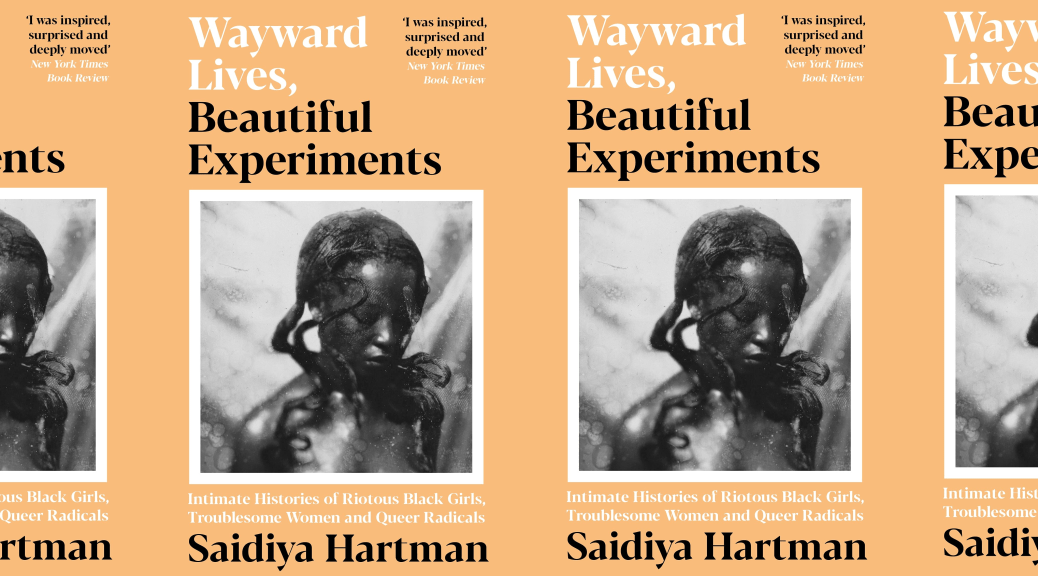
Wednesday 29th October 2025: Black History Month – Wayward Lives, Beautiful Experiments by Saidiya Hartman

On Wednesday 29th October 2025, from 7.30-9.30pm, Stroud Radical Reading Group will host a discussion of Wayward Lives, Beautiful Experiments, Intimate Histories of Riotous Black Girls, Troublesome Women and Queer Radicals, Saidiya Hartman. We will meet at Redz Youth Hub, 6 Threadneedle St, GL5 1AF. Entry is free and anyone interested in the book is welcome – you don’t need to have read it to join us. See below for more information.

October is Black History Month and while this isn’t the only book of Black history we are discussing this year, it is a book that explore Black history.

Wayward Lives… look at how, at the dawn of the twentieth century, black women in the US were carving out new ways of living. The first generations born after emancipation, their struggle was to live as if they really were free.

Below in our resources section you can find a link to buy the book at a discount, content notes, free audio/visual resources and a 20 page excerpt from the book. There is also more information about the book and Stroud Radical Reading Group events.

Entry to the reading group session is free and everyone is welcome – you do not need to have attended previous sessions, and we do our best to make the sessions welcoming to people who have not been to reading groups or similar settings like university seminars before.

We encourage people to read the whole book, but you are welcome to attend to listen to the discussion without reading any of it. An excerpt, podcast interview, and youtube video are available for those who do not have the time or money for the whole book.

Content notes:

Graphic: Racism, Racial slurs, Rape

Moderate: Sexual violence, Domestic abuse, Sexual assault

Also mentioned: Pedophilia, Slavery, Sexual harassment

Taken from Storygraph – click for more detail

About the book:

In Wayward Lives, Beautiful Experiments, Saidiya Hartman deploys both radical scholarship and profound literary intelligence to examine the transformation of intimate life that Black women in the generations born after emancipation instigated in the USA. With visionary intensity, she conjures their worlds, their dilemmas, their defiant brilliance.

These women refused to labour like slaves. Wrestling with the question of freedom, they invented forms of love and solidarity outside convention and law. These were the pioneers of free love, common-law and transient marriages, queer identities, and single motherhood – all deemed scandalous, even pathological, at the dawn of the twentieth century, though they set the pattern for the world to come.

About the author

Saidiya Hartman is an American academic and writer focusing on African-American studies. She is currently a professor at Columbia University in their English department. Her work focuses on African-American literature, cultural history, photography and ethics, and the intersections of law and literature.

As well as Wayward Lives, she is the author Scenes of Subjection: Terror, Slavery, and Self-Making in Nineteenth-Century America (1997), Lose Your Mother: A Journey Along the Atlantic Slave Route (2007)

Resources

About our events

Stroud Radical Reading Group events are free to attend, though we will make a collection to cover venue hire costs – please bring some cash if you can afford it (a few pounds would be great).

We try to create a comfortable discussion space for everyone, including people who have not been part of a reading group or been to university. We do not want the sessions to feel like school – the idea is that everyone has something to contribute, even if primarily through finding the discussion texts difficult and having questions with other attendees can attempt to answer.

To ensure marginalised people feel welcome, we encourage care and thoughtful contributions that respect people’s identities and lives. We are an LGBTQ+ inclusive and anti-racist space.

Anyone is welcome to listen to the discussion, though we encourage contributions only from those who have read at least some of the book we are discussing.

There is an opportunity for more informal discussion after the session in the Ale House pub for anyone who wants to continue their evening.

About the venue

The venue for this session is Redz Youth Hub, a hub for organising, creativity, and community building. It’s a free space for young people to host their own events, workshops, and meetups. They’ve been hosting sessions by Mutiny: Stroud’s Youth Assembly and The RYSE – the Radical Youth Space for Educations – see their schedule for the rest of the year here, including sessions on the Peace Movement, Stroud Water riots, and decolonial action.

Redz is in central Stroud, close to the train station and bus station, with nearby stands to lock bikes, and parking for cars nearby at Fawkes Place or Church St car park. It is one street over from John St – for those who have joined recent sessions at Creative Sustainability. Please get in touch if you’d like to get more of an idea of what the sessions are like or if you have any accessibility needs.

Saturday 28th June 2025 – Black on Both Sides

On Saturday 28th June 2025, from 7.30-9.30pm, Stroud Radical Reading Group will host a discussion of C. Riley Snorton’s Black on Both Sides: a racial history of trans identity. We have selected the final chapter, “DeVine’s Cut” as a focus chapter for those unable to read the full book – and will spend around half the discussion time on this. See below for links to download the chapter free as a pdf, buy the book at a discount from the local Yellow Lighted Bookshop and to view free audio/visual resources relevant to the book.

We will meet at Creative Sustainability’s shopfront space at 10 John St, GL5 2HA (a short distance from the town centre train or bus station, with parking available nearby at Church St).

Entry is free and everyone is welcome – you do not need to have attended previous sessions, and we do our best to make the sessions welcoming to people who have not been to reading groups or similar settings like university seminars before.

We’re reading Black on Both Sides at the recommendation of a participant in the reading group. Our discussion comes at a time of increasing hostility (in legislation, media, and public) to trans people in the UK – and elsewhere around the world, for example the USA and Hungary, and rising racism.

Our discussion is on a Saturday – unlike usual. This is because it will take place the night after Stroud Pride’s annual event. This year this will begin with a Parade at 11am, followed by entertainment, information stands, and stalls selling goods from 12noon at Bank Gardens (GL5 1BB, mapcarta map, Accessible Gloucestershire’s images and description of access). It would be great to see Radical Reading Group members at these events earlier in the day too!

Content notes:

This is an academic book and can be hard to read. As with all SRRG sessions, the idea is that collective discussion will help us to explore and improve our understanding of the difficult content.

This is a book that deals with many difficult topics, including in graphic ways. Obviously, Transphobia, Racism and Sexism are covered extensively. The following is a summary of additional content notes for the whole book from StoryGraph:
Ableism, Bullying, Deadnaming, domestic abuse, Emotional abuse, Gun violence hate crime, Homophobia, Injury detail, Torture, Slavery, Discussion of mental illness, Medical trauma, Misogyny, Murder, Physical abuse, Police brutality, Rape, Sexual assault/violence.

The chapter “DeVine’s Cut” which we will focus on, specifically references 3 murders.

More information about the books, venue and how sessions work is below.

About the book:

“In Black on Both Sides, C. Riley Snorton identifies multiple intersections between blackness and transness from the mid-nineteenth century to present-day anti-black and anti-trans legislation and violence.

Drawing on a deep and varied archive of materials—early sexological texts, fugitive slave narratives, Afro-modernist literature, sensationalist journalism, Hollywood films—Snorton attends to how slavery and the production of racialized gender provided the foundations for an understanding of gender as mutable.

In tracing the twinned genealogies of blackness and transness, Snorton follows multiple trajectories, from the medical experiments conducted on enslaved black women by J. Marion Sims, the “father of American gynecology,” to the negation of blackness that makes transnormativity possible.

Revealing instances of personal sovereignty among blacks living in the antebellum North that were mapped in terms of “cross dressing” and canonical black literary works that express black men’s access to the “female within,” Black on Both Sides concludes with a reading of the fate of Phillip DeVine, who was murdered alongside Brandon Teena in 1993, a fact omitted from the film Boys Don’t Cry out of narrative convenience.”

About the author:

C. Riley Snorton is Visiting Associate Professor of American Studies and Ethnicity at the University of Southern California and Associate Professor of Africana Studies at Cornell University. He earned his PhD in Communication and Culture, with graduate certificates in Africana Studies and Gender and Sexuality Studies from the University of Pennsylvania in 2010. Snorton’s research and teaching expertise include cultural theory, queer and transgender theory and history, Africana studies, performance studies, and popular culture.

Snorton’s first book, Nobody Is Supposed to Know: Black Sexuality on the Down Low (University of Minnesota Press, 2014), traces the emergence and circulation of the down low in news and popular culture.

Resources

About our events and the venue

Stroud Radical Reading Group events are free to attend, though we will make a collection to cover venue hire costs – please bring some cash.

We try to create a comfortable discussion space for everyone, including people who have not been part of a reading group or been to university. We do not want the sessions to feel like school – the idea is that everyone has something to contribute, even if primarily through finding the discussion texts difficult and having questions with other attendees can attempt to answer.

To ensure marginalised people feel welcome, we encourage care and thoughtful contributions that respect people’s identities and lives. We are an LGBTQ+ inclusive and anti-racist space.

Anyone is welcome to listen to the discussion, though we encourage contributions only from those who have read at least some of the book we are discussing.

There is an opportunity for more informal discussion after the session in the Ale House pub for anyone who wants to continue their evening.

About the venue

We will meet at the Creative Sustainability shopfront space at 10 John St, GL5 2HA (round the corner from Iceland and next to the Ale House pub). This is close to the train station and not far from the bus station. There are stands to lock bikes to outside, and parking for cars nearby at Church St car park. There are no toilets at the venue. There is a small step to access the building, which is then step free). The room is well lit. Please get in touch if you’d like to get more of an idea of what the sessions are like or if you have any accessibility needs.

March 30th 2022: We Can Do Better Than This

On Wednesday 30th March 2022 at 7.30pm we will discuss “We Can Do Better Than This, 35 Voices on the Future of LGBTQ+ Rights” edited by Amelia Abraham.

Stroud Radical Reading Group events are free to attend, online events, be held via videocall. Anyone is welcome, but we keep link details private – please contact us for the Zoom details. You are welcome to attend to listen to the discussion even if you do not have time to engage with any of the content. Free resources are listed below, but if you can, please buy a reduced copy from The Yellow-Lighted Bookshop (RRP is £14.99 but add coupon “StroudRadical” at the checkout to buy a copy for £13.19 – saving £1.80 or 12%). An ebook version is available via publishers Penguin.

We will focus our discussion on 4 essays in particular. We welcome people who are not able to read the book in full, or even a single one of the 35 essays.

  • Crystal’s Make-Up by Tom Rasmussen
  • Leaving Bangladesh by Mazharul Islam
  • Kissing in Public by Shura, and
  • Kito Diaries by Vincent Desmond

Read these below or click to download 4 essays (pdf) from We Can Do Better Than This. Please be aware that the essays feature accounts that may make for difficult reading. The issues covered in the book include hate crimes, mental health, medical treatment, sex and relationships, and substance abuse. Some of these are covered in the four essays we will focus on too.

“We talk about achieving ‘LGBTQ+ equality’, but around the world, LGBTQ+ people are still suffering discrimination and extreme violence. How do we solve this urgent problem, allowing queer people everywhere the opportunity to thrive? In We Can Do Better Than This, 35 voices explore this question. Through deeply moving stories and provocative new arguments on safety and visibility, dating and gender, care and community, they present a powerful manifesto for how – together – we can start to create a better future.”

Read the four focus chapters below:

The following articles by authors of the chapters are available free online:

Queer: A Graphic History, Wednesday 23rd February 2022

On Wednesday Feb 23rd from 7.30pm, we will discuss “Queer: A Graphic History” online via video-call. Please click to contact us for the details. You can buy a reduced copy from The Yellow Lighted Bookshop (RRP is £14.99 but add coupon “StroudRadical” at the checkout to buy a copy for £13.19 – saving £1.80 or 12%).

“Activist-academic Meg-John Barker and cartoonist Jules Scheele illuminate the histories of queer thought and LGBTQ+ action…”

“A kaleidoscope of characters from the diverse worlds of pop culture, film, activism and acaedia… guide us on a journey through the ideas, people and events that have shaped queer theory. From identity politics and gender roles to privilege and exclusion, Queer explores how we came to view sex, gender and sexuality in the ways that we do, and how culture can shift our perspective of what’s ‘normal’.” – book jacket

It’s harder than usual to create a focus text this month, but as ever we welcome people who are not able to read the book (or read it in full). If you can’t access the book, please try to watch the videos below. People are always welcome to come along and listen if they’ve not had time to engage with any of the content

The first video is under 3 minutes and offers a very quick glance and overview of the book:

The second, 20 minute, video features an interview with Meg-John Barker on a tour of places that are important to them –  queer and trans friendly hairdressers Open Barbers, LGBT health and well-being centre London Friend where Meg-John works as a counsellor once a week, and the Open University branch in Camden where Barket often attends events or hosts meetings. They talk about “lots of topics including therapy, love, gender, sexual and relationship diversity, the need (or not) for labels, kink, and what kind of cake I prefer!”

February is LGBTQ history month in the UK, coinciding with a major celebration of the 2003 abolition of Section 28 (which prohibited the “promotion of homosexuality” by local authorities – effectively banning discussion and presentation of resources).