
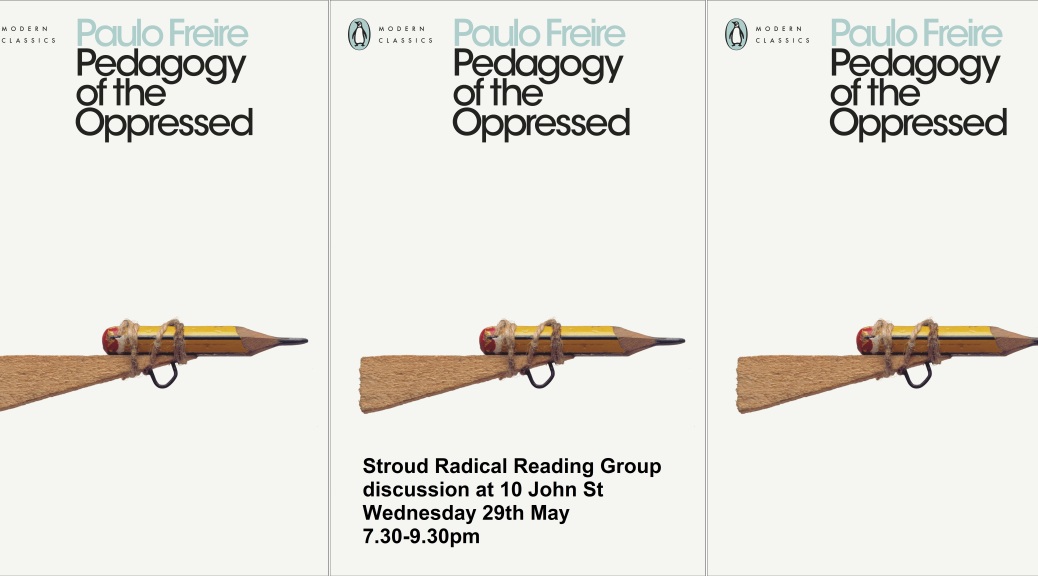
On Wednesday 29th May 2024, from 7.30-9.30pm, Stroud Radical Reading Group will host a discussion of Pedagogy of the Oppressed. We will meet at 10 John St, GL5 2AH. Below you can find links to a free copy of the book as a pdf, to buy a physical copy of the book at a discount, information about the event, venue and more. We’ll be looking at three quotes in particular, discussing them in small groups. If you don’t have time to read the full book, we recommend Chapter 2 (pages 71-86).
This book argues that the perceived passivity of the poor is the direct result of economic, social and political domination. It suggests that in some countries the oppressors use the ‘piggy bank’ system – treating students as passive, empty vessels – to preserve their authority and maintain a culture of silence. Through cooperation and dialogue, Freire suggests, the authoritarian teacher-pupil model can be replaced with critical thinking so that the student becomes co-creator of knowledge. Crucial to Freire’s argument is the belief that every human being, no matter how impoverished or illiterate, can develop an awareness of self, and the right to be heard.
You can buy the book from the Yellow Lighted Bookshop (Nailsworth, Tetbury or Chalford pick up or delivery at £3.50) via the previous link – RRP £9.99. When looking at your “basket” enter the “couponcode” stroudradical24 for a 12% discount – final book price £8.79, a saving of £1.20).
Event format
At this event we’ll focus on three quotes – which you can read below. We’ll discuss these in small groups before coming together as a single group at the end of the meeting to share reflections that have come up through those discussions or from reading parts of the book we haven’t been able to discuss. We’ll start the session with an invitation to share brief personal thoughts on our own experiences of education.
The three quotes – which can be read in context from the full book available free as a pdf (from libcom.org) are:
- From Chapter 2 (page 73) “This solution is not (nor can it be) found in the banking concept.
On the contrary, banking education maintains and even stimulates the contradiction through the following attitudes and practices, which mirror oppressive society as a whole:
(a) the teacher teaches and the students are taught;
(b) the teacher knows everything and the students know nothing;
(c) the teacher thinks and the students are thought about;
(d) the teacher talks and the students listen—meekly;
(e) the teacher disciplines and the students are disciplined;
(f) the teacher chooses and enforces his choice, and the students comply;
(g) the teacher acts and the students have the illusion of acting through the action of the teacher;
(h) the teacher chooses the program content, and the students (who were not consulted) adapt to it;
(i) the teacher confuses the authority of knowledge with his or her own professional authority, which she and he sets in opposition to the freedom of the students;
(j) the teacher is the Subject of the learning process, while the pupils are mere objects.
It is not surprising that the banking concept of education regards men as adaptable, manageable beings. The more students work at storing the deposits entrusted to them, the less they develop the critical consciousness which would result from their intervention in the world as transformers of that world. The more completely they accept the passive role imposed on them, the more they tend simply to adapt to the world as it is and to the fragmented view of reality deposited in them.” - From Chapter 4 (page 149): “In the words of Francisco Weffert:
All the policies of the Left are based on the masses and depend on the consciousness of the latter. If that consciousness is confused, the Left will lose its roots and certain downfall will be imminent, although (as in the Brazilian case) the Left may be deluded into thinking it can achieve the revolution by means of a quick return to power.
In a situation of manipulation, the Left is almost always tempted by a “quick return to power,” forgets the necessity of joining with the oppressed to forge an organization, and strays into an impossible “dialogue” with the dominant elites. It ends by being manipulated by these elites, and not infrequently itself falls into an elitist game, which it calls “realism.”
Manipulation, like the conquest whose objectives it serves, attempts to anesthetize the people so they will not think. For if the people join to their presence in the historical process critical thinking about that process, the threat of their emergence materializes in revolution. Whether one calls this correct thinking “revolutionary consciousness” or “class consciousness,” it is an indispensable precondition of revolution. The dominant elites are so well aware of this fact that they instinctively use all means, including physical violence, to keep the people from thinking. They have a shrewd intuition of the ability of dialogue to develop a capacity for criticism.” - From Chapter 4 (page 128): “Dialogue with the people is radically necessary to every authentic revolution. This is what makes it a revolution, as distinguished from a military coup. One does not expect dialogue from a coup—only deceit (in order to achieve “legitimacy”) or force (in order to repress).
Sooner or later, a true revolution must initiate a courageous dialogue with the people. Its very legitimacy lies in that dialogue. It cannot fear the people, their expression, their effective participation in power. It must be accountable to them, must speak frankly to them of its achievements, its mistakes, its miscalculations, and its difficulties.
The earlier dialogue begins, the more truly revolutionary will the movement be. The dialogue which is radically necessary to revolution corresponds to another radical need: that of women and men as beings who cannot be truly human apart from communication, for they are essentially communicative creatures. To impede com munication is to reduce men to the status of “things”—and this is a job for oppressors, not for revolutionaries.
Let me emphasize that my defense of the praxis implies no dichotomy by which this praxis could be divided into a prior stage of reflection and a subsequent stage of action. Action and reflection occur simultaneously.”
About our events and the venue
Stroud Radical Reading Group events are free to attend, though we will make a collection to cover costs – please bring some cash. Anyone is welcome to listen to the discussion, though we encourage contributions only from those who have read at least some of the book we are discussing. We try to create a comfortable discussion space for everyone, including people who have not been part of a reading group or been to university.
We will meet at 10 John St, GL5 2AH. This is near the centre of town, a short walk from Stroud Railway Station and a slightly longer walk from the Merrywalks Bus Station. There are stands to lock bikes to outside, and parking for cars nearby in either Brunel Mall, Fawkes Place, or Church St car park. There is a low step to enter the building, which is flat. There are no toilet facilities. Please get in touch if you’d like to get more of an idea of what the sessions are like or if you have any accessibility needs.
About the book and author
Paulo Reglus Neves Freire (19 September 1921 – 2 May 1997) was a Brazilian educator and philosopher who was a leading advocate of critical pedagogy. His influential work Pedagogy of the Oppressed is generally considered one of the foundational texts of the critical pedagogy movement, and was the third most cited book in the social sciences as of 2016 according to Google Scholar. Freire joined the Workers’ Party (PT) in São Paulo and acted as a supervisor for its adult literacy project from 1980 to 1986. When the Workers’ Party won the 1988 São Paulo mayoral elections in 1988, Freire was appointed municipal Secretary of Education.
Freire wrote Pedagogy of the Oppressed between 1967 and 1968, while living in the United States. Originally written in his native Portuguese, Pedagogy of the Oppressed was first published in Spanish in 1968
Due to the 1964 Brazilian coup d’état, where a military dictatorship was put in place with the support of the United States, Paulo Freire was exiled from his home country, an exile that lasted 16 years. After a brief stay in Bolivia, he moved to Chile in November 1964 and stayed until April 1969 when he accepted a temporary position at Harvard University. His four-and-a-half year stay in Chile impacted him intellectually, pedagogically, and ideologically, and contributed significantly to the theory and analysis he presents in Pedagogy of the Oppressed. In Freire’s own words:
When I wrote [Pedagogy of the Oppressed] I was already completely convinced of the problem of social classes. In addition, I wrote this book on the basis of my extensive experience with peasants in Chile; being absolutely convinced of the process of ideological hegemony and what that meant. When I would hear the peasants speaking, I experienced the whole problem of the mechanism of domination (which I analyze in the first chapter of the book)…Certainly, in my earliest writings I did not make this explicit, because I did not perceive it yet as such…[Pedagogy of the Oppressed] is also completely situated in a historical reality.
Free resources:
- Chapter 2 available free as a pdf
- Full book available free as a pdf (from libcom.org)
- Full audiobook available free on YouTube
- 8 minute video of Paulo Freire’s last public interview, given to Literacy.org in 1996 (embedded below)
- 90 minute video of discussion of the book’s impact and relevance to education today, featuring Noam Chomsky, Howard Gardner, and Bruno della Chiesa, commemorating the 45th anniversary of the publication (embedded below)
 Stroud Radical Reading Group