
Tag Archives: Ecology

Sunday 30th July 2023: After Geoengineering by Holly Jean Buck

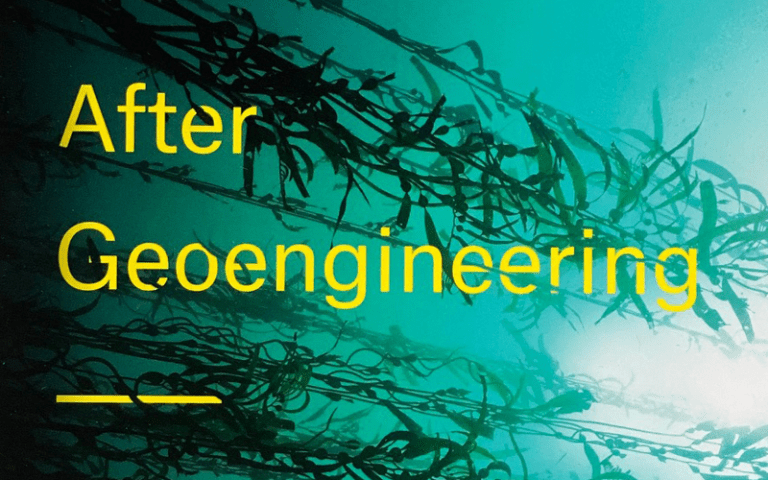
On Sunday 30th July 2023, from 7.30-9.30pm at The RYSE, 2 Bath St, Stroud Radical Reading Group will discuss After Geoengineering: Climate Trajedy, Repair, and Restoration, by Holly Jean Buck. The book explores how “We are right to fear that geoengineering will be used to maintain the status quo” but asks “is there another possible future after geoengineering?”. On this webpage you can find a link to buy the book at a discount, free resources, and information about the author, the book, how our sessions work, and the venue.

At the time of writing, you can buy a copy of the book from publishers Verso for £11.89 (hardback) or £7 (ebook). Both prices represent a 30% discount on the RRP.

This discussion is part our series on climate change, but you are welcome to join the discussion even if you cannot make the other events. You are also welcome even if you haven’t read the book or the free section of it available below – to listen to the discussion and ask questions.

Freely available resources related to the book are available below. We like to ensure everyone can attendee our sessions and get something out of them even if they can’t afford to buy a copy of the book or the time to read it. We would encourage people to read/listen to as much as possible, but you are welcome to attend and listen along even if you are unable to engage with any of the below.

Free resources

Freely available resources related to the book are available below. We like to ensure everyone can attendee our sessions and get something out of them even if they can’t afford to buy a copy of the book or the time to read it. We would encourage people to read/listen to as much as possible, but you are welcome to attend and listen along even if you are unable to engage with any of the below:

About the author and the book

Holly Jean Buck is a geographer and environmental social scientist studying rural futures, the politics of platforms, and how emerging technologies can address environmental challenges. She works as an Assistant Professor of Environment and Sustainability at the University at Buffalo in Buffalo, New York. She is also the author of Ending Fossil Fuels: Why Net Zero Is Not Enough.

“Climate engineering is a dystopian project. But as the human species hurtles ever faster towards its own extinction, geoengineering as a temporary fix, to buy time for carbon removal, is a seductive idea. We are right to fear that geoengineering will be used to maintain the status quo, but is there another possible future after geoengineering? Can these technologies and practices be used to bring carbon levels back down to pre-industrial levels? Are there possibilities for massive intentional intervention in the climate that are democratic, decentralised, or participatory?

These questions are provocative, because they go against a binary that has become common sense: geoengineering is assumed to be on the side of industrial agriculture, inequality and ecomodernism, in opposition to degrowth, renewable energy, sustainable agriculture and climate justice. After Geoengineering rejects this binary, to ask: what if the people seized the means of climate production? Both critical and utopian, the book examines the possible futures after geoengineering. Rejecting the idea that geoengineering is some kind of easy work-around, Holly Buck outlines the kind of social transformation that would be necessary to enact a programme of geoengineering in the first place.”

Endorsements:

“In the face of rapid climate change, how should we think about geoengineering? In this timely and bold book, Holly Jean Buck lays out a case for approaching geoengineering from the Left. Blending journalistic insight with scientific speculation, After Geoenginneeringinspires much-needed thought experiments about the changes coming to our warmer and weirder world.

Joel Wainwright, author of Decolonizing Development, Geopiracy, and Climate Leviathan (with Geoff Mann)

This is the guide to the future. There’s hardly anything scarier than geoengineering, but it is coming towards us, closer for every day of CO2 spewed into the air. It can no longer be wished away – and thankfully, we have Holly Jean Buck to explain what it might look like and how it could be survived, perhaps even used for the good of the planet. Written in graceful prose, combining the latest science with the crystal ball of a sci-fi author, this book shines. Anyone worried about what comes next should read it.

Andreas Malm, author of The Progress of This Storm and Fossil Capital

About Stroud Radical Reading Group events and the venue

Our events are free to attend, though we will collect donations to cover the costs of venue hire on a donate-what-you-can-afford basis. We try to ensure the discussions are welcoming to new people, including people who have never been to a reading group before – and you don’t have to have been to university. You don’t even have to have read any of the book – you can just come along and listen to the discussion. Some free resources including a sample chapter we’ll focus our discussion on are included above, and we’d encourage people to read/listen to as much as they can ahead of the session.

James facilitates the sessions, which we start and finish with everyone having a short time to introduce themselves, and mention something that struck them about the reading or which they’d like to discuss. The conversation then flows, with people using hands to indicate they’d like to speak – and we try to make sure everyone gets a chance. Sometimes we identify particular questions to think about during a session or even before it.

The RYSE is a new venue for us – it is accessed by a staircase. Please contact us if you have any accessibility requirements, or other questions about how the events work.

We will keep windows open for ventilation, hand sanitiser is provided, and we ask people who are ill to stay away (whether they are ill with covid or something else). Attendees do not generally wear masks but we will be respectful to anyone who chooses to and other members may wear masks at request of other attendees – let us know your preferences in advance.

Climate Change – our May to July 2023 series

We’ll host three events exploring issues related to climate change between May and July – all 7.30-9.30pm but on different nights of the week and at a couple of different venues. All events are free and everyone is welcome, as ever – you don’t need to have read the book to come along and listen. Full information and free resources are available via the links below.

White Skin, Black Fuel: On the Danger of Fossil Fascism by Andreas Malm and the Zetkin Collective – Wednesday May 31st at The Exchange, Brick Row

The Solutions Are Already Here: Strategies for Ecological Revolution from Below by Peter Gelderloos – Saturday 24th June at The RYSE – 2 Bath St

After Geoengineering: Climate Tragedy, Repair and Restoration by Holly Jean Buck – Sunday 30th July at The RYSE – 2 Bath St

See poster below. Download a copy as a pdf (131kb) and help us publicise the events.

May 31st 2023: The Danger of Fossil Fascism


On Wednesday 31st May, from 7.30-9.30pm at The Exchange, Brick Row, Stroud (GL5 1DF), Stroud Radical Reading Group will discuss “White Skin, Black Fuel: On The Danger of Fossil Fascism” by Andreas Malm and the Zetkin Collective.

This discussion will be the fifth and final of a monthly series looking at antifascism. You do not need to attend previous sessions in the series to come to or get something out of this session, though of course we recommend coming along to the other sessions too (if you’ve heard about them in time).

We will focus our discussion on Chapter 8: “Mythical Energies of the Far Right” (pdf 352kb). The 9 page introduction is also available to download (pdf 161kb) or read on a laptop/desktop online (scroll to the bottom of this page).

The full book is currently available from publishers Verso at a 15% discount: White Skin, Black Fuel – £17.00 with a free-ebook instead of the RRP of £20, or £6 for the e-book alone.

Freely available resources related to the book are available below. We like to ensure everyone can attendee our sessions and get something out of them even if they can’t afford to buy a copy of the book or the time to read it. We would encourage people to read/listen to as much as possible, but you are welcome to attend and listen along even if you are unable to engage with any of the below.

Information about White Skin, Black Fuel from the publishers Verso:

“What does the rise of the far right mean for the battle against climate change? In the first study of the far right’s role in the climate crisis, White Skin, Black Fuel presents an eye-opening sweep of a novel political constellation, revealing its deep historical roots. Fossil-fuelled technologies were born steeped in racism. No one loved them more passionately than the classical fascists. Now right-wing forces have risen to the surface, some professing to have the solution—closing borders to save the nation as the climate breaks down. Epic and riveting, White Skin, Black Fuel traces a future of political fronts that can only heat up.”

About the Zetkin Collective

The Zetkin Collective is a group of scholars and activists working on the political ecology of the far right. It was formed around the Human Ecology division at Lund University in the summer of 2018. Conducting research in their native languages, the contributing authors to the book White Skin, Black Fuel are: Irma Allen, Anna Bartfai, Bernadette Barth, Lise Benoist, Julia Bittencourt Costa Moreira, Dounia Boukaouit, Clàudia Custodio, Philipa Olivia Dige, Ilaria di Meo, George Edwards, Morten Hesselbjerg, Ståle Holgersen, Claire Lagier, Andreas Malm, Sonja Pietiläinen, Daria Rivin, Line Skovlund Larsen, Luzia Strasser, Laudy van den Heuvel, Meike Vedder and Anoushka Eloise Zoob Carter.

Learn more about Zetkin Collective and its members on their website.”

About Stroud Radical Reading Group events and the venue

Our events are free to attend, though we will collect donations to cover the costs of venue hire on a donate-what-you-can-afford basis. We try to ensure the discussions are welcoming to new people, including people who have never been to a reading group before – and you don’t have to have been to university. You don’t even have to have read any of the book – you can just come along and listen to the discussion. Some free resources including a sample chapter we’ll focus our discussion on are included below though, and we’d encourage people to read/listen to as much as they can ahead of the session.

The Exchange has step-free access. We will keep windows open for ventilation, hand sanitiser is provided, and we ask people who are ill to stay away (whether they are ill with covid or something else). Attendees do not generally wear masks but we will be respectful to anyone who chooses to and other members may wear masks at request of other attendees – let us know your preferences in advance. Please contact us if you have any accessibility requirements, or other questions about how the events work.

2020 Series 2: Debates around social ecology

Our monthly events in spring 2020 will form a series on “Debates around social ecology”. Each of these three events will be held on the last Wednesday of the month, 7.30-9.30pm – online via Zoom. See poster and text below it for more details.

Poster with concentric circles in different colours, "Debates around Social Ecology" title, and details contained in webpage text

29th April: Ecological Marxism and environmental neo-Malthusianism

We will discuss “Ecological Marxism vs. environmental neo-Malthusianism: An old debate continues” (online article) by Brian Napoletano.

Let us know you plan to attend via the Facebook event: Ecological Marxism and environmental neo-Malthusianism

27th May: Social Ecology and Deep Ecology

We will discuss the introduction to “Defending the Earth: A Debate”. Download the 8,000 word introduction as an ODT file (should open in most word processing programmes), the full text is available online. The book is based on a 1989 public debate between social ecology theorist Murray Bookchin and deep ecology activist Dave Foreman.

While we will focus on the Introductory section, I recommending reading more of the text if you are able to. You down the 10,000 word closing section of the book as an ODT file. This is made up of two essays from Bookchin and Foreman on their reflections on the debate, written one year later (10,000 words). This might be of particular interest.

Let us know you plan to attend via the Facebook event: Social Ecology and Deep Ecology

24th June: Green New Deal and Beyond

We will discuss “‘We have a once-in-century chance’: Naomi Klein on how we can fight the climate crisis“, a selection from Klein’s latest book “On Fire: The (Burning) Case for a Green New Deal“,  together with a critical review by Angela Mitropoulos, “Playing With Fire: Securing the Borders of a Green New Deal“.

Let us know you plan to attend via the Facebook event: Green New Deal and Beyond.


Down to Earth by Bruno Latour – 15th May 2019

As part of our summer series on climate and environmental crises, we will discuss Bruno Latour’s Down To Earth: Politics in the New Climatic Regime on Wednesday 15th May, 7.30-9.30pm at Black Book Cafe. Facebook event: Down to Earth-Bruno Latour – SRRG discussion.

The book is available for £12.99 from Stroud Bookshop (we can negotiate a small discount through bulk purchase if enough people want a copy) but we will focus our discussion on chapters 1-5 and 20 of Latour’s book – excerpts available as a pdf here (pages 1-21, 99-106).

From the publisher’s page about the book: “The present ecological mutation has organized the whole political landscape for the last thirty years. This could explain the deadly cocktail of exploding inequalities, massive deregulation, and conversion of the dream of globalization into a nightmare for most people.

What holds these three phenomena together is the conviction, shared by some powerful people, that the ecological threat is real and that the only way for them to survive is to abandon any pretense at sharing a common future with the rest of the world. Hence their flight offshore and their massive investment in climate change denial.

The Left has been slow to turn its attention to this new situation. It is still organized along an axis that goes from investment in local values to the hope of globalization and just at the time when, everywhere, people dissatisfied with the ideal of modernity are turning back to the protection of national or even ethnic borders.

This is why it is urgent to shift sideways and to define politics as what leads toward the Earth and not toward the global or the national. Belonging to a territory is the phenomenon most in need of rethinking and careful redescription; learning new ways to inhabit the Earth is our biggest challenge. Bringing us down to earth is the task of politics today.”

Chapter titles of the sections forming our focus for discussion:

Chapter 1: “A hypothesis as political fiction: the explosion of inequalities and the denial of climate change are one and the same phenomenon.”

Chapter 2: Thanks to America’s abandonment of the climate agreement, we now know clearly what war has been declared

Chapter 3:  The question of migrations now concerns everyone, offering a new and very wicked universality: finding oneself deprived of ground

Chapter 4: One must take care not to confuse globalization-plus with globalization-minus

Chapter 5. How the globalist ruling classes have decided to abandon all the burdens of solidarity, little by little

Chapter 20: “A personal defence of the Old Continent”