On Wednesday 26th June 2024, from 7.30-9.30pm, Stroud Radical Reading Group will host a discussion of Burning Country: Syrians in Revolution and War by Robin Yassin-Kassab and Leila Al-Shami. We will meet at 10 John St, GL5 2AH. Below you can find links to a free copy of the book as a pdf, to buy a physical copy of the book at a discount, information about the event, venue and free resources.
In 2011, many Syrians took to the streets of Damascus to demand the overthrow of the government of Bashar al-Assad. Burning Country explores the horrific and complicated reality of life in present-day Syria.
You can buy the book from the Yellow Lighted Bookshop (Nailsworth, Tetbury or Chalford pick up or delivery at £3.50) via the previous link – RRP £14.99. When looking at your “basket” enter the “couponcode” stroudradical24 for a 12% discount – final book price £13.19, a saving of £1.80).
Event format
We are very fortunate that one of the authors, Robin Yassin-Kassab, is hoping to join us half way through the meeting to answer questions about the book. We will also be joined by Rami, a Syrian refugee living locally.
About our events and the venue
Stroud Radical Reading Group events are free to attend, though we will make a collection to cover costs – please bring some cash. Anyone is welcome to listen to the discussion, though we encourage contributions only from those who have read at least some of the book we are discussing. We try to create a comfortable discussion space for everyone, including people who have not been part of a reading group or been to university.
We will meet at 10 John St, GL5 2AH. This is near the centre of town, a short walk from Stroud Railway Station and a slightly longer walk from the Merrywalks Bus Station. There are stands to lock bikes to outside, and parking for cars nearby in either Brunel Mall, Fawkes Place, or Church St car park. There is a low step to enter the building, which is flat. There are no toilet facilities. Please get in touch if you’d like to get more of an idea of what the sessions are like or if you have any accessibility needs.
About the book and authors
“Burning Country explores the horrific and complicated reality of life in present-day Syria with unprecedented detail and sophistication, drawing on new first hand testimonies from opposition fighters, exiles lost in an archipelago of refugee camps, and courageous human rights activists among many others. These stories are expertly interwoven with a trenchant analysis of the brutalisation of the conflict and the militarisation of the uprising, of the rise of the Islamists and sectarian warfare, and the role of governments in Syria and elsewhere in exacerbating those violent processes. With chapters focusing on ISIS and Islamism, regional geopolitics, the new grassroots revolutionary organisations, and the worst refugee crisis since World War Two, Burning Country is a vivid and groundbreaking look at a modern-day political and humanitarian nightmare.”
Robin Yassin-Kassab is a regular media commentator on Syria and the Middle East. He is the author of the novel The Road from Damascus (Penguin, 2009) and contributor to Syria Speaks (Saqi, 2014).
Leila Al-Shami has worked with the human rights movement in Syria and across in the Middle East. She is a founding member of Tahrir-ICN, a network that aimed to connect anti-authoritarian struggles across the Middle East, North Africa and Europe.
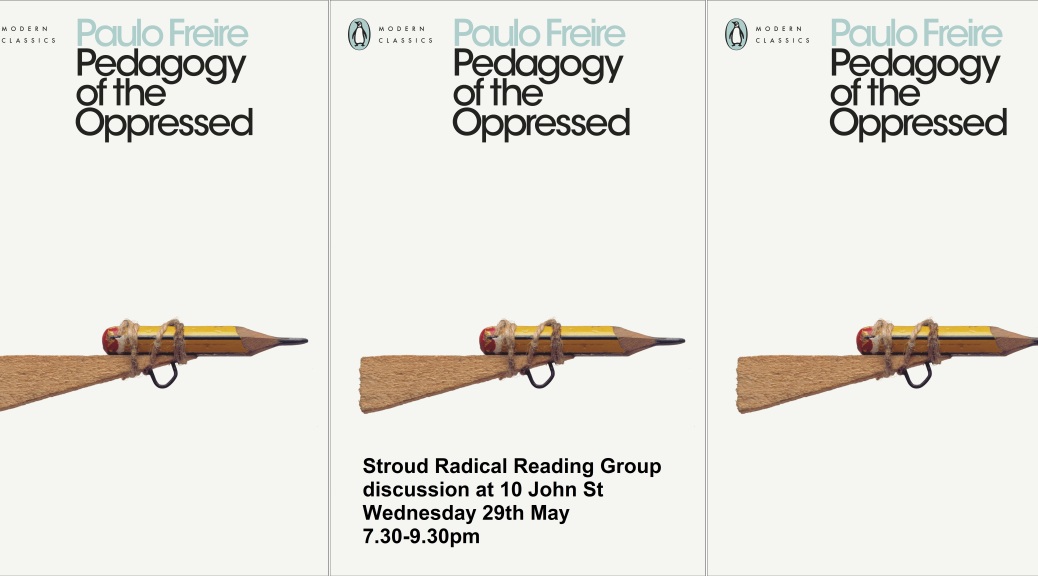
On Wednesday 29th May 2024, from 7.30-9.30pm, Stroud Radical Reading Group will host a discussion of Pedagogy of the Oppressed. We will meet at 10 John St, GL5 2AH. Below you can find links to a free copy of the book as a pdf, to buy a physical copy of the book at a discount, information about the event, venue and more. We’ll be looking at three quotes in particular, discussing them in small groups. If you don’t have time to read the full book, we recommend Chapter 2 (pages 71-86).
This book argues that the perceived passivity of the poor is the direct result of economic, social and political domination. It suggests that in some countries the oppressors use the ‘piggy bank’ system – treating students as passive, empty vessels – to preserve their authority and maintain a culture of silence. Through cooperation and dialogue, Freire suggests, the authoritarian teacher-pupil model can be replaced with critical thinking so that the student becomes co-creator of knowledge. Crucial to Freire’s argument is the belief that every human being, no matter how impoverished or illiterate, can develop an awareness of self, and the right to be heard.
You can buy the book from the Yellow Lighted Bookshop (Nailsworth, Tetbury or Chalford pick up or delivery at £3.50) via the previous link – RRP £9.99. When looking at your “basket” enter the “couponcode” stroudradical24 for a 12% discount – final book price £8.79, a saving of £1.20).
Event format
At this event we’ll focus on three quotes – which you can read below. We’ll discuss these in small groups before coming together as a single group at the end of the meeting to share reflections that have come up through those discussions or from reading parts of the book we haven’t been able to discuss. We’ll start the session with an invitation to share brief personal thoughts on our own experiences of education.
From Chapter 2 (page 73) “This solution is not (nor can it be) found in the banking concept. On the contrary, banking education maintains and even stimulates the contradiction through the following attitudes and practices, which mirror oppressive society as a whole: (a) the teacher teaches and the students are taught; (b) the teacher knows everything and the students know nothing; (c) the teacher thinks and the students are thought about; (d) the teacher talks and the students listen—meekly; (e) the teacher disciplines and the students are disciplined; (f) the teacher chooses and enforces his choice, and the students comply; (g) the teacher acts and the students have the illusion of acting through the action of the teacher; (h) the teacher chooses the program content, and the students (who were not consulted) adapt to it; (i) the teacher confuses the authority of knowledge with his or her own professional authority, which she and he sets in opposition to the freedom of the students; (j) the teacher is the Subject of the learning process, while the pupils are mere objects. It is not surprising that the banking concept of education regards men as adaptable, manageable beings. The more students work at storing the deposits entrusted to them, the less they develop the critical consciousness which would result from their intervention in the world as transformers of that world. The more completely they accept the passive role imposed on them, the more they tend simply to adapt to the world as it is and to the fragmented view of reality deposited in them.”
From Chapter 4 (page 149): “In the words of Francisco Weffert: All the policies of the Left are based on the masses and depend on the consciousness of the latter. If that consciousness is confused, the Left will lose its roots and certain downfall will be imminent, although (as in the Brazilian case) the Left may be deluded into thinking it can achieve the revolution by means of a quick return to power. In a situation of manipulation, the Left is almost always tempted by a “quick return to power,” forgets the necessity of joining with the oppressed to forge an organization, and strays into an impossible “dialogue” with the dominant elites. It ends by being manipulated by these elites, and not infrequently itself falls into an elitist game, which it calls “realism.” Manipulation, like the conquest whose objectives it serves, attempts to anesthetize the people so they will not think. For if the people join to their presence in the historical process critical thinking about that process, the threat of their emergence materializes in revolution. Whether one calls this correct thinking “revolutionary consciousness” or “class consciousness,” it is an indispensable precondition of revolution. The dominant elites are so well aware of this fact that they instinctively use all means, including physical violence, to keep the people from thinking. They have a shrewd intuition of the ability of dialogue to develop a capacity for criticism.”
From Chapter 4 (page 128): “Dialogue with the people is radically necessary to every authentic revolution. This is what makes it a revolution, as distinguished from a military coup. One does not expect dialogue from a coup—only deceit (in order to achieve “legitimacy”) or force (in order to repress). Sooner or later, a true revolution must initiate a courageous dialogue with the people. Its very legitimacy lies in that dialogue. It cannot fear the people, their expression, their effective participation in power. It must be accountable to them, must speak frankly to them of its achievements, its mistakes, its miscalculations, and its difficulties. The earlier dialogue begins, the more truly revolutionary will the movement be. The dialogue which is radically necessary to revolution corresponds to another radical need: that of women and men as beings who cannot be truly human apart from communication, for they are essentially communicative creatures. To impede com munication is to reduce men to the status of “things”—and this is a job for oppressors, not for revolutionaries. Let me emphasize that my defense of the praxis implies no dichotomy by which this praxis could be divided into a prior stage of reflection and a subsequent stage of action. Action and reflection occur simultaneously.”
About our events and the venue
Stroud Radical Reading Group events are free to attend, though we will make a collection to cover costs – please bring some cash. Anyone is welcome to listen to the discussion, though we encourage contributions only from those who have read at least some of the book we are discussing. We try to create a comfortable discussion space for everyone, including people who have not been part of a reading group or been to university.
We will meet at 10 John St, GL5 2AH. This is near the centre of town, a short walk from Stroud Railway Station and a slightly longer walk from the Merrywalks Bus Station. There are stands to lock bikes to outside, and parking for cars nearby in either Brunel Mall, Fawkes Place, or Church St car park. There is a low step to enter the building, which is flat. There are no toilet facilities. Please get in touch if you’d like to get more of an idea of what the sessions are like or if you have any accessibility needs.
About the book and author
Paulo Reglus Neves Freire (19 September 1921 – 2 May 1997) was a Brazilian educator and philosopher who was a leading advocate of critical pedagogy. His influential work Pedagogy of the Oppressed is generally considered one of the foundational texts of the critical pedagogy movement, and was the third most cited book in the social sciences as of 2016 according to Google Scholar. Freire joined the Workers’ Party (PT) in São Paulo and acted as a supervisor for its adult literacy project from 1980 to 1986. When the Workers’ Party won the 1988 São Paulo mayoral elections in 1988, Freire was appointed municipal Secretary of Education.
Freire wrote Pedagogy of the Oppressed between 1967 and 1968, while living in the United States. Originally written in his native Portuguese, Pedagogy of the Oppressed was first published in Spanish in 1968
Due to the 1964 Brazilian coup d’état, where a military dictatorship was put in place with the support of the United States, Paulo Freire was exiled from his home country, an exile that lasted 16 years. After a brief stay in Bolivia, he moved to Chile in November 1964 and stayed until April 1969 when he accepted a temporary position at Harvard University. His four-and-a-half year stay in Chile impacted him intellectually, pedagogically, and ideologically, and contributed significantly to the theory and analysis he presents in Pedagogy of the Oppressed. In Freire’s own words:
When I wrote [Pedagogy of the Oppressed] I was already completely convinced of the problem of social classes. In addition, I wrote this book on the basis of my extensive experience with peasants in Chile; being absolutely convinced of the process of ideological hegemony and what that meant. When I would hear the peasants speaking, I experienced the whole problem of the mechanism of domination (which I analyze in the first chapter of the book)…Certainly, in my earliest writings I did not make this explicit, because I did not perceive it yet as such…[Pedagogy of the Oppressed] is also completely situated in a historical reality.
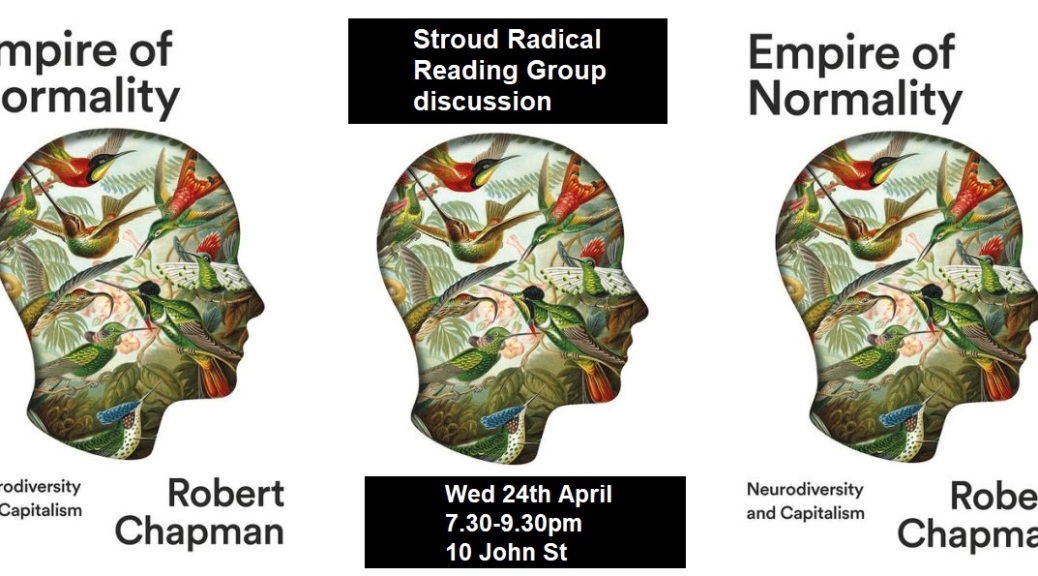
On Wednesday 24th April 2024, from 7.30-9.30pm, Stroud Radical Reading Group will host a discussion of Empire of Normality – Neurodiversity and Capitalism by Robert Chapman. We will meet at 10 John St, GL5 2AH. Below you can find links to a free extract, to buy a copy of the book at a discount, information about the venue and more.
Exploring the rich histories of the neurodiversity and disability movements, Robert Chapman shows how the rise of capitalism created an ’empire of normality’ that transformed our understanding of the body into that of a productivity machine. Robert Chapman (they/them) is a neurodivergent academic with an interest in emancipatory politics, social theory, disability, and mental health
You can buy the book from the Yellow Lighted Bookshop (Nailsworth, Tetbury or Chalford pick up or delivery at £3.50) via the previous link – RRP £14.99. When looking at your “basket” enter the “couponcode” stroudradical24 for a 12% discount – final book price £13.19, a saving of £1.80).
About our events and the venue
Stroud Radical Reading Group events are free to attend, though we will make a collection to cover costs – please bring some cash. Anyone is welcome to listen to the discussion, though we encourage contributions only from those who have read at least some of the book we are discussing. We try to create a comfortable discussion space for everyone, including people who have not been part of a reading group or been to university.
We will meet at 10 John St, GL5 2AH. This is near the centre of town, a short walk from Stroud Railway Station and a slightly longer walk from the Merrywalks Bus Station. There are stands to lock bikes to outside, and parking for cars nearby in either Brunel Mall, Fawkes Place, or Church St car park. There is a low step to enter the building, which is flat. There are no toilet facilities. Please get in touch if you’d like to get more of an idea of what the sessions are like or if you have any accessibility needs.
About the book and author
Neurodiversity is on the rise. Awareness and diagnoses have exploded in recent years, but we are still missing a wider understanding of how we got here and why. Beyond simplistic narratives of normativity and difference, this groundbreaking book exposes the very myth of the ‘normal’ brain as a product of intensified capitalism.
Exploring the rich histories of the neurodiversity and disability movements, Robert Chapman shows how the rise of capitalism created an ’empire of normality’ that transformed our understanding of the body into that of a productivity machine.
Neurodivergent liberation is possible – but only by challenging the deepest logics of capitalism. Empire of Normality is an essential guide to understanding the systems that shape our bodies, minds and deepest selves – and how we can undo them.
Robert Chapman (they/them) is a neurodivergent academic with an interest in emancipatory politics, social theory, disability, and mental health
On Wednesday 27th March 2024, from 7.30-9.30pm, Stroud Radical Reading Group will host a discussion of Doppelganger – a trip into the Mirror World by Naomi Klein. We will meet at Stroud Chocolate House, 2 Bedford Street – Stroud – GL5 1AY. Below you can find links to free excerpts, to buy a copy of the book at a discount, information about the venue and more.
Doppelganger is a guidebook for our unsettling age, inviting all of us to view our reflections in the looking glass. It’s for anyone who has lost hours down an internet rabbit hole, who wonders why our politics has become so fatally warped, and who wants a way out of our collective vertigo and back to fighting for what really matters. Braiding together elements of tragicomic memoir, chilling political reportage, and cobweb-clearing cultural analysis, Naomi Klein dives deep into what she calls the Mirror World—our destabilized present rife with doubles and confusion, where far right movements playact solidarity with the working class, AI-generated content blurs the line between genuine and spurious, New Age wellness entrepreneurs turned anti-vaxxers further scramble our familiar political allegiances, and so many of us project our own carefully curated digital doubles out into the social media sphere.
You can buy the book from the Yellow Lighted Bookshop (Nailsworth, Tetbury or Chalford pick up or delivery at £3.50) via the previous link – RRP £25. When looking at your “basket” enter the “couponcode” stroudradical24 for a 12% discount – final book price £22, a saving of £3).
This follows a discussion on 28th February 2024 of Conspirituality: How New Age Conspiracy Theories Became a Health Threat – which covers similar issues and can also be bought from the Yellow Lighted Bookshop. You don’t have to have attended the previous event to join us to discuss the Naomi Klein book.
About our events and the venue
Stroud Radical Reading Group events are free to attend, though we will make a collection to cover costs. Anyone is welcome to listen to the discussion, though we encourage contributions only from those who have read at least some of the book we are discussing. We try to create a comfortable discussion space for everyone, including people who have not been part of a reading group or been to university.
We will meet at Stroud Chocolate House, 2 Bedford Street – Stroud – GL5 1AY. This is just off the Stroud High St. There is parking nearby in Fawkes Place, and step-free access. Drinks will be available – please bring some cash. Please get in touch if you’d like to get more of an idea of what the sessions are like or if you have any accessibility needs.
About the book
When Naomi Klein discovered that a woman who shared her first name, but had radically different, harmful views, was getting chronically mistaken for her, it seemed too ridiculous to take seriously. Then suddenly it wasn’t. She started to find herself grappling with a distorted sense of reality, becoming obsessed with reading the threats on social media, the endlessly scrolling insults from the followers of her doppelganger. Why had her shadowy other gone down such an extreme path? Why was identity – all we have to meet the world – so unstable? To find out, Klein decided to follow her double into a bizarre, uncanny mirror world: one of conspiracy theories, anti-vaxxers and demagogue hucksters, where soft-focus wellness influencers make common cause with fire-breathing far right propagandists (all in the name of protecting ‘the children’).
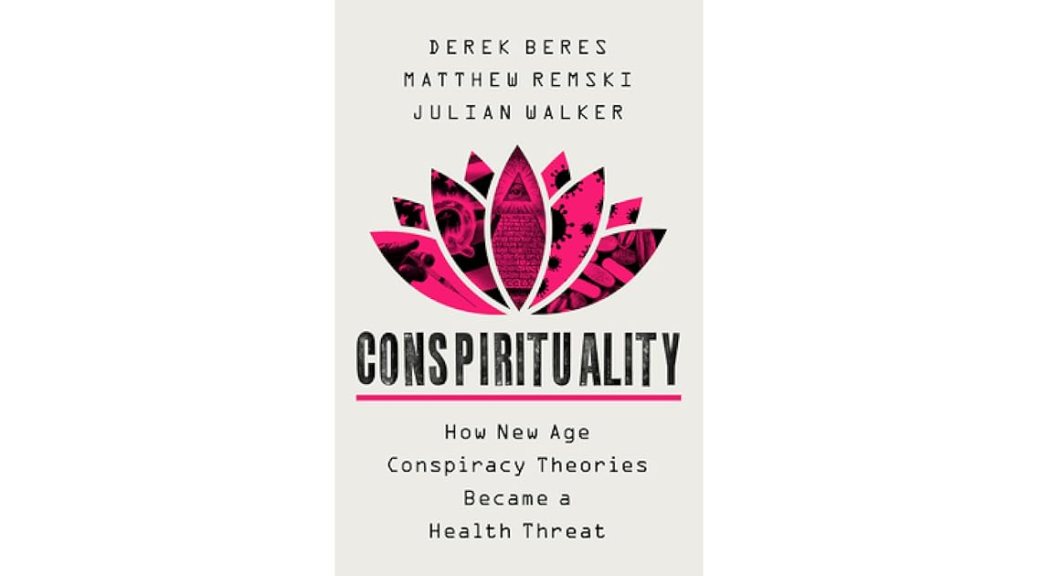
On Wednesday 28th Feburary 2024, from 7.30-9.30pm, Stroud Radical Reading Group will host a discussion of Conspirituality: How New Age Conspiracy Theories Became a Health Threat, a book by Derek Beres, Matthew Remski and Julian Walker – hosts of the Conspirituality podcast. We will meet at Stroud Chocolate House, 2 Bedford Street – Stroud – GL5 1AY (see below for more venue details).
Conspirituality takes a deep dive into the troubling phenomenon of influencers who have curdled New Age spirituality and wellness with the politics of paranoia—peddling vaccine misinformation, tales of child trafficking, and wild conspiracy theories.
You can buy the book from the Yellow Lighted Bookshop (Nailsworth, Tetbury or Chalford pick up or delivery at £3.50) via the previous link – RRP £25. When looking at your “basket” enter the “couponcode” stroudradical24 for a 12% discount – final book price £22, a saving of £3).
We will follow this session with a discussion on 27th March 2024 of Naomi Klein’s Doppelganger: a trip into the mirror world – which covers similar issues and can also be bought from the Yellow Lighted Bookshop.
About our events and the venue
Stroud Radical Reading Group events are free to attend, though we will make a collection to cover costs. Anyone is welcome to listen to the discussion, though we encourage contributions only from those who have read at least some of the book. We try to create a comfortable discussion space for everyone, including people who have not been part of a reading group or been to university.
We will meet at Stroud Chocolate House, 2 Bedford Street – Stroud – GL5 1AY. This is just off the Stroud High St. There is parking nearby in Fawkes Place, and step-free access. Drinks will be available – please bring some cash. Please get in touch if you’d like to get more of an idea of what the sessions are like or if you have any accessibility needs.
About the book
Since May 2020, Derek Beres, Matthew Remski and Julian Walker have used their Conspirituality podcast to expose countless facets of the intersection of alt-health practitioners with far-right conspiracy trolls. Now this expansive and revelatory book unpacks the follies, frauds, cons and cults that dominate the New Age and wellness spheres and betray the trust of people who seek genuine relief in this uncertain age.
With analytical rigor and irreverent humor, Conspirituality offers an antidote to our times, helping readers recognize wellness grifts, engage with loved ones who’ve fallen under the influence, and counter lies and distortions with insight and empathy.
On this page you will find a list of titles of the books we will read and discuss in 2024. When we have full details for events, there will be a link to a separate page on this site for each events. Until then, there are links to buy the books from the Yellow Lighted Bookshop (YLB – where you can buy them with a 12% discount by entering the coupon code “stroudradical24”).
The Drowned and The Saved is a book of eight essays by Italian-Jewish author, Primo Levi. It is his last work, written a year before his death. It is an analytical book about life and death in the Nazi extermination camps, informed by Levi’s personal experience as a survivor of Auschwitz.
You can buy the book from the Yellow Lighted Bookshop (Nailsworth, Tetbury or Chalford pick up or delivery at £3.50) via the previous link – RRP £10.99. When looking at your “basket” enter the “couponcode” stroudradical24 for a 12% discount – final book price £9.67, a saving of £1.32)
Stroud Radical Reading Group events are free to attend, though we will make a collection to cover costs. Anyone is welcome to listen to the discussion, though we encourage contributions only from those who have read at least some of the book. If you do not have time to read the whole book, please choose a single essay to read.
Also taking place on Sunday January 28th at 7.30pm is a screening of Denial, as part of Stroud Film Festival. The film is based on the acclaimed book History on Trial: My Day in Court with a Holocaust Denier by Deborah Lipstadt. More information and tickets available to buy online from the Festival website. Tickets are be priced at £6 – cheaper tickets (£4) are available to people on low incomes, and people who are able can pay £8 to ‘pay it forward’.
A 4 minute video from the United States Holocaust Memorial Museum, introducing Primo Levi through the context of the typescript of Levi’s first book that his American relatives recently donated to the Museum (embedded below)
We’ll meet at 10 John St – the old Electric Bike Shop, next to the Ale House pub and currently home to Access Bike/Creative Sustainability. More info on the venue below.
As publishers Verso say: “The Care Manifesto puts care at the heart of the debates of our current crisis: from intimate care—childcare, healthcare, elder care—to care for the natural world. We live in a world where carelessness reigns, but it does not have to be this way.”
On this webpage you can find free resources including free downloads of two chapters and a free online version of the whole book, details to buy a copy of the book at a discount, and information about the author, the book, how our sessions work, and the venue.
We will focus our discussion on chapters 3 and 6, and the following questions. Thanks to Benjamin – who will introduce the session – for coming up with these:
What can we do to create more caring kinships/communities/states?
Is there a conflict between indiscriminate and emotionally invested care? Can/should either be enforced?
In a world so empty of care, should caring people extend their care as far as possible to make up for this, or is it enough to care as much as they would in a caring world?
What role does the state have in a non-hierarchical caring society?
We enourage people to read the whole 97 page book but you are also welcome to listen to the discussion and ask questions even if you haven’t read the book (or engaged with other the free resources).
Resources related to the book are available below – most are free. We like to ensure everyone can attendee our sessions and get something out of them even if they can’t afford to buy a copy of the book or the time to read it. We would encourage people to read/listen to as much as possible, but you are welcome to attend and listen along even if you are unable to engage with any of the below. Audio/visual materials are provided for anyone who prefers these to reading – don’t feel you have to read content to attend the ‘reading’ group. The aim is to discuss the ideas – however they have been presented.
We’ll meet at 10 John St – the old Electric Bike Shop, next to the Ale House pub and currently home to Access Bike/Creative Sustainability. There’s one small step to enter the shop, then access is level. There are a couple of sofas and some harder chairs. There’s good lighting, and lots of room. It’s not an easy space to keep warm but there are heaters and some blankets. If you have any questions about acessibility or the venue, please get in touch.
About the author and the book
The Care Collective was formed in 2017, originally as a London-based reading group aiming to understand and address the multiple and extreme crises of care. Each coming from a different discipline, we have been active both collectively and individually in diverse personal, academic and political contexts. Members include: Andreas Chatzidakis, Jamie Hakim, Jo Littler, Catherine Rottenberg, and Lynne Segal.
Publishers Verso say:
The Care Manifesto puts care at the heart of the debates of our current crisis: from intimate care—childcare, healthcare, elder care—to care for the natural world. We live in a world where carelessness reigns, but it does not have to be this way.
The Care Manifesto puts forth a vision for a truly caring world. The authors want to reimagine the role of care in our everyday lives, making it the organising principle in every dimension and at every scale of life. We are all dependent on each other, and only by nurturing these interdependencies can we cultivate a world in which each and every one of us can not only live but thrive.
The Care Manifesto demands that we must put care at the heart of the state and the economy. A caring government must promote collective joy, not the satisfaction of individual desire. This means the transformation of how we organise work through co-operatives, localism and nationalisation. It proposes the expansion of our understanding of kinship for a more ‘promiscuous care’. It calls for caring places through the reclamation of public space, to make a more convivial city. It sets out an agenda for the environment, most urgent of all, putting care at the centre of our relationship to the natural world.”
Endorsements:
“The Care Manifesto is a radiant invitation to transform our economy and society, a roadmap for how we can emerge from overlapping crises and weave a new social fabric. The ethic of universal care is an antidote to the spiralling carelessness that our current system shows towards people and the planet. The authors understand that care is not a commodity: it’s a practice, a core value, and an organizing principle on which a new politics can and must be built.” – Naomi Klein
“This manifesto is a call to action for global progressives. The Care Collective shows the “systemic carelessness” of existing political, economic, and kinship orders are broken both for humans and the planet. They demonstrate that capacious care offers a practical and already existing starting point for change on all levels” – Joan Tronto, author of Caring Democracy
“In showing us the power of mutual aid, coalition-building and solidarity, this book aids us in ensuring our activism is enacted through our daily actions within our communities and that whilst change starts within us, it doesn’t end there” – Adele Walton, gal-dem
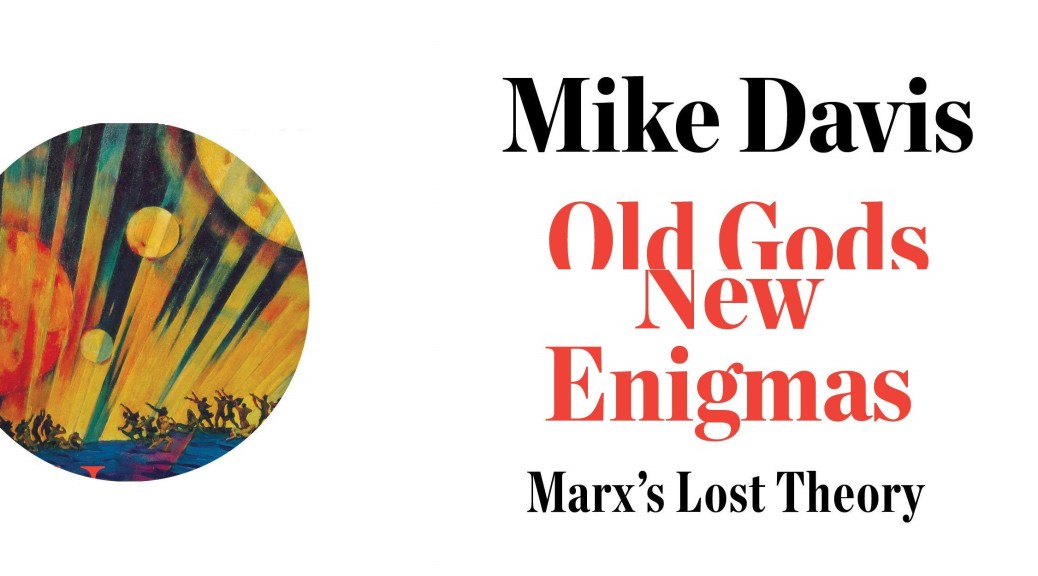
On Wednesday 25th October 2023, from 7.30-9.30pm, Stroud Radical Reading Group will discuss Old Gods, New Enigmas by Mike Davis. Davis died on October 25th last year, and we will meet to honour his life and work on the anniversary of his death. Davis was an American writer, political activist, urban theorist, and historian based in Southern California. He was been described as the “Best Socialist Writer of the Last Half Century“.
As usual we’ll discuss what we made of the book and how it might be relevant to us in our own lives. We will focus on Chapter 4 – “Who Will Build the Ark?” which explores global warming, how “city life is rapidly destroying the ecological niche-Holocene climate stability-which made its evolution and complexity possible”, and “the city as its own solution”. We enourage people to read the whole book but you are also welcome even if you haven’t read even the Chapter – to listen to the discussion and ask questions.
On this webpage you can find free resources, details to buy the book at a discount, and information about the author, the book, how our sessions work, and the venue. We’re planning to once again be at the SISTER House – as this is a building Stroud in Internationalist Solidarity Together for Earth Repairs (SISTER) have reclaimed on Lansdown Road.
Freely available resources related to the book are available below. We like to ensure everyone can attendee our sessions and get something out of them even if they can’t afford to buy a copy of the book or the time to read it. We would encourage people to read/listen to as much as possible, but you are welcome to attend and listen along even if you are unable to engage with any of the below. Audio/visual materials are provided for anyone who prefers these to reading – don’t feel you have to read content to attend the ‘reading’ group. The aim is to discuss the ideas – however they have been presented.
This book is the second in a 3-part series on Crisis, Mutual Aid, and Radical Action, which will also cover work by the Care Collective (full details to follow). You can come even if you didn’t attend the previous event, and you don’t have to come to the next one.
About the author and the book
Publishers Verso say:
“Mike Davis spent years working factory jobs and sitting behind the wheel of an eighteen wheeler before his profile as one of the world’s leading urbanists emerged with the publication of his sober, if dystopian survey of Los Angeles. Since then, he’s developed a reputation not only for his caustic analysis of ecological catastrophe and colonial history, but as a stylist without peer.
Old Gods, New Enigmas is Davis’s book-length engagement with Karl Marx, marking the 200th anniversary of Marx’s birth and exploring Davis’s thinking on history, labor, capitalism, and revolution – themes ever present the early work from this leading radical thinker. This will be his first book on Marxism itself.
In a time of ubiquitous disgust with political and economic elites, explores the question of revolutionary agency—what social forces and conditions do we need to transform the current order?—and the situation of the world’s working classes from the US to Europe to China. Even the most preliminary tasks are daunting. A new theory of revolution needs to return to the big issues in classical socialist thought, such as clarifying “proletarian agency”, before turning to the urgent questions of our time: global warming, the social and economic gutting of the rustbelt, and the city’s demographic eclipse of the countryside. What does revolution look like after the end of history?”
Endorsements:
“There is no one better at building on Marx’s legacy of profound and engaged politcal analysis than Mike Davis” – Leo Panitch
“The heterogeneity of Davis’s latest book Old Gods, New Enigmas reflects his decades of accumulated interests…a formidable intellectual, and this collection contains many gems.” – Troy Vettese, Boston Review
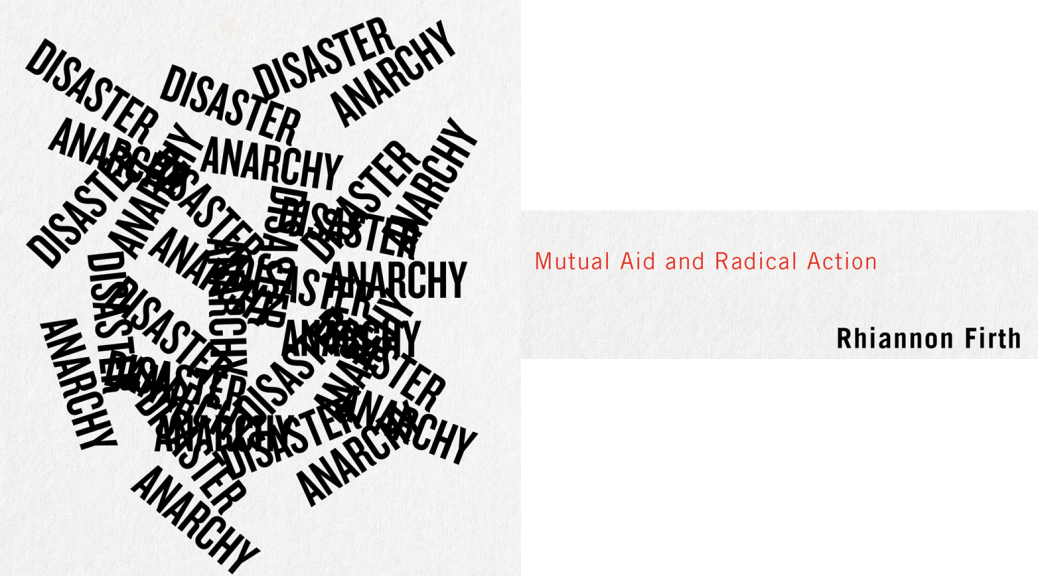
On Wednesday 27th September 2023, from 7.30-9.30pm, Stroud Radical Reading Group will discuss Disaster Anarchy: Mutual Aid and Radical Action by Rhiannon Firth. The book looks at the disasters of Hurricane Sandy, Covid-19, and the social movements that mobilised relief in their wake – often on anarchist principles, contrasting these with the “Disaster Capitalism” and ensuring that collective solidarity in a dangerous world isn’t missed in academic “Disaster Studies”.
As usual we’ll discuss what we made of the book and how it might be relevant to us in our own lives. We enourage people to read the book but you are also welcome even if you haven’t read the book – to listen to the discussion and ask questions. This book is the first in a 3-part series on Crisis, Mutual Aid, and Radical Action, which will also cover work by Mike Davis and the Care Collective (full details to follow). You don’t have to attend all the events in the series, but you are invited to!
On this webpage you can find details to buy the book at a discount, free resources, and information about the author, the book, how our sessions work, and the venue. We’re planning to once again be at the SISTER Summer School – but as this is a building Stroud in Internationalist Solidarity Together for Earth Repairs (SISTER) have reclaimed on Lansdown Road.
After August, the book is available from Yellow Lighted Bookshop for £19.99, and you should be able to get a 12% discount: after adding the book to your ‘basket’, view your basket where there is an option to enter a ‘Coupon code’. Add the code “StroudRadical23” and click/tap “Apply coupon” (final cost should then be £17.59).
Freely available resources related to the book are available below. We like to ensure everyone can attendee our sessions and get something out of them even if they can’t afford to buy a copy of the book or the time to read it. We would encourage people to read/listen to as much as possible, but you are welcome to attend and listen along even if you are unable to engage with any of the below.
Two excerpts from the book have been published in Dope Magazine which is distributed on the streets of Stroud by people experiencing homelessness, and available online as a pdf: Issue 21 has part one, Issue 22 has part two.
Audio interview with Rhiannon Firth discussing the ‘Politics of Care and a Utopian Future‘ on the ‘Politics of Care in Pandemic Time’ podcast series (35 minutes – this podcast looks at Firth’s work before Disaster Anarchy was published)
Video of Rhiannon Firth discussing Anarchy, Utopia and Mutual Aid with the Anarchism Research Group (18 minutes)
Rhiannon Firth is currently a lecturer in Sociology at UCL. She is the author of two books: Utopian Politics: Citizenship and Practice and Coronavirus, Class and Mutual Aid in the UK. She is active in social movements and popular education projects in London.
Publishers Pluto Press say:
“Anarchists have been central in helping communities ravaged by disasters, stepping in when governments wash their hands of the victims. Looking at Hurricane Sandy, Covid-19, and the social movements that mobilised relief in their wake, Disaster Anarchy is an inspiring and alarming book about collective solidarity in an increasingly dangerous world.
As climate change and neoliberalism converge, mutual aid networks, grassroots direct action, occupations and brigades have sprung up in response to this crisis with considerable success. Occupy Sandy was widely acknowledged to have organised relief more effectively than federal agencies or NGOs, and following Covid-19 the term ‘mutual aid’ entered common parlance.
However, anarchist-inspired relief has not gone unnoticed by government agencies. Their responses include surveillance, co-option, extending at times to violent repression involving police brutality. Arguing that disaster anarchy is one of the most important political phenomena to emerge in the twenty-first century, Rhiannon Firth shows through her research on and within these movements that anarchist theory and practice is needed to protect ourselves from the disasters of our unequal and destructive economic system.”
Endorsements:
‘Commendable – a book that prepares us to think about and react to system failures’ – Peter Gelderloos
‘Firth bridges the theories and methodologies in the continuing development of anarchist and liberatory frameworks of decentralised disaster responses, first articulated after Hurricane Katrina. They demonstrate through personal histories and analysis deeper paths forward in anarchist processes and practices that allow our liberatory imaginations to resist the collapse while creating viable alternatives without state coercion or interference’ – scott crow, author of ‘Black Flags and Windmills: Hope , Anarchy and the Common Ground Collective’
‘A clear, timely and rigorous account of anarchist responses to catastrophes. It avoids romanticisation, as Rhiannon Firth incisively unpicks state and corporate strategies of co-option’ – Benjamin Franks, Senior Lecturer in Social and Political Philosophy, University of Glasgow
Stroud Radical Reading Group meets once a month. Here you can find details of sessions, links, and further information