Tag Archives: Capitalism

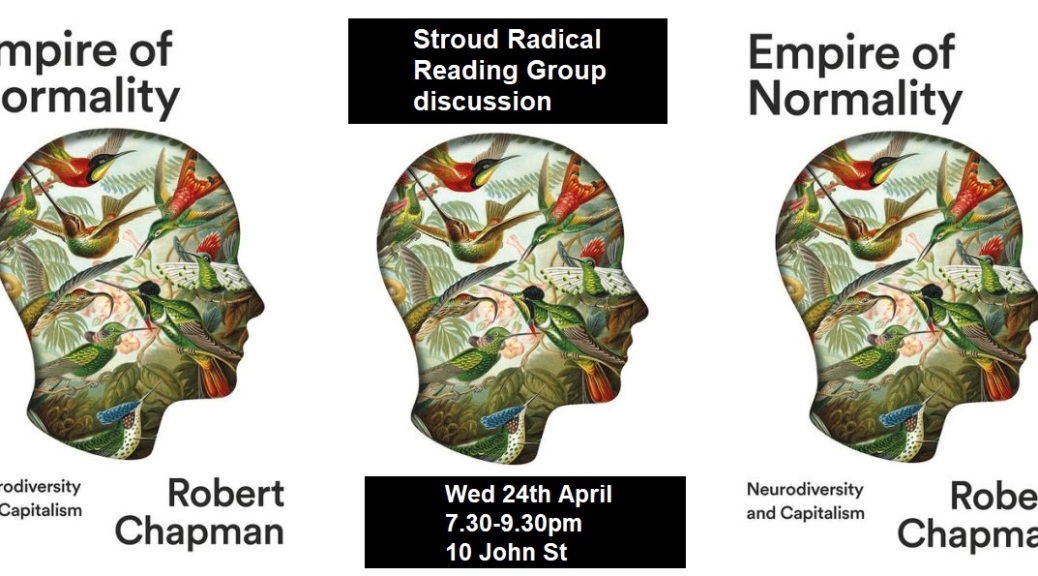
April 24th 2024: Empire of Normality – Neurodiversity and Capitalism by Robert Chapman

On Wednesday 24th April 2024, from 7.30-9.30pm, Stroud Radical Reading Group will host a discussion of Empire of Normality – Neurodiversity and Capitalism by Robert Chapman. We will meet at 10 John St, GL5 2AH. Below you can find links to a free extract, to buy a copy of the book at a discount, information about the venue and more.

Exploring the rich histories of the neurodiversity and disability movements, Robert Chapman shows how the rise of capitalism created an ’empire of normality’ that transformed our understanding of the body into that of a productivity machine. Robert Chapman (they/them) is a neurodivergent academic with an interest in emancipatory politics, social theory, disability, and mental health

Till the 14th April you can buy the book from publishers Pluto at 40% off – £8.99 for the paperback or £5.99 for the e-book.

You can buy the book from the Yellow Lighted Bookshop (Nailsworth, Tetbury or Chalford pick up or delivery at £3.50) via the previous link – RRP £14.99. When looking at your “basket” enter the “couponcode” stroudradical24 for a 12% discount – final book price £13.19, a saving of £1.80).

About our events and the venue

Stroud Radical Reading Group events are free to attend, though we will make a collection to cover costs – please bring some cash. Anyone is welcome to listen to the discussion, though we encourage contributions only from those who have read at least some of the book we are discussing. We try to create a comfortable discussion space for everyone, including people who have not been part of a reading group or been to university.

We will meet at 10 John St, GL5 2AH. This is near the centre of town, a short walk from Stroud Railway Station and a slightly longer walk from the Merrywalks Bus Station. There are stands to lock bikes to outside, and parking for cars nearby in either Brunel Mall, Fawkes Place, or Church St car park. There is a low step to enter the building, which is flat. There are no toilet facilities. Please get in touch if you’d like to get more of an idea of what the sessions are like or if you have any accessibility needs.

About the book and author

Neurodiversity is on the rise. Awareness and diagnoses have exploded in recent years, but we are still missing a wider understanding of how we got here and why. Beyond simplistic narratives of normativity and difference, this groundbreaking book exposes the very myth of the ‘normal’ brain as a product of intensified capitalism.

Exploring the rich histories of the neurodiversity and disability movements, Robert Chapman shows how the rise of capitalism created an ’empire of normality’ that transformed our understanding of the body into that of a productivity machine.

Neurodivergent liberation is possible – but only by challenging the deepest logics of capitalism. Empire of Normality is an essential guide to understanding the systems that shape our bodies, minds and deepest selves – and how we can undo them.

Robert Chapman (they/them) is a neurodivergent academic with an interest in emancipatory politics, social theory, disability, and mental health

Free resources:

Wednesday 6th December 2023: The Care Manifesto

On Wednesday 6th December 2023, from 7.30-9.30pm, Stroud Radical Reading Group will discuss The Care Manifesto: The Politics of Interdependence by The Care Collective.

We’ll meet at 10 John St – the old Electric Bike Shop, next to the Ale House pub and currently home to Access Bike/Creative Sustainability. More info on the venue below.

As publishers Verso say: “The Care Manifesto puts care at the heart of the debates of our current crisis: from intimate care—childcare, healthcare, elder care—to care for the natural world. We live in a world where carelessness reigns, but it does not have to be this way.”

On this webpage you can find free resources including free downloads of two chapters and a free online version of the whole book, details to buy a copy of the book at a discount, and information about the author, the book, how our sessions work, and the venue.

We will focus our discussion on chapters 3 and 6, and the following questions. Thanks to Benjamin – who will introduce the session – for coming up with these:

  1. What can we do to create more caring kinships/communities/states?
  2. Is there a conflict between indiscriminate and emotionally invested care? Can/should either be enforced?
  3. In a world so empty of care, should caring people extend their care as far as possible to make up for this, or is it enough to care as much as they would in a caring world?
  4. What role does the state have in a non-hierarchical caring society?

We enourage people to read the whole 97 page book but you are also welcome to listen to the discussion and ask questions even if you haven’t read the book (or engaged with other the free resources).

Resources related to the book are available below – most are free. We like to ensure everyone can attendee our sessions and get something out of them even if they can’t afford to buy a copy of the book or the time to read it. We would encourage people to read/listen to as much as possible, but you are welcome to attend and listen along even if you are unable to engage with any of the below. Audio/visual materials are provided for anyone who prefers these to reading – don’t feel you have to read content to attend the ‘reading’ group. The aim is to discuss the ideas – however they have been presented.

Resources

This book is the third in a 3-part series on Crisis, Mutual Aid, and Radical Action, following books by Mike Davis on Marxism in the Anthropocene and Rhiannon Firth on Mutual Aid and Radical Action . You can come even if you didn’t attend the previous events.

About the venue

We’ll meet at 10 John St – the old Electric Bike Shop, next to the Ale House pub and currently home to Access Bike/Creative Sustainability. There’s one small step to enter the shop, then access is level. There are a couple of sofas and some harder chairs. There’s good lighting, and lots of room. It’s not an easy space to keep warm but there are heaters and some blankets. If you have any questions about acessibility or the venue, please get in touch.

About the author and the book

The Care Collective was formed in 2017, originally as a London-based reading group aiming to understand and address the multiple and extreme crises of care. Each coming from a different discipline, we have been active both collectively and individually in diverse personal, academic and political contexts. Members include: Andreas Chatzidakis, Jamie Hakim, Jo Littler, Catherine Rottenberg, and Lynne Segal.

Publishers Verso say:

The Care Manifesto puts care at the heart of the debates of our current crisis: from intimate care—childcare, healthcare, elder care—to care for the natural world. We live in a world where carelessness reigns, but it does not have to be this way.

The Care Manifesto puts forth a vision for a truly caring world. The authors want to reimagine the role of care in our everyday lives, making it the organising principle in every dimension and at every scale of life. We are all dependent on each other, and only by nurturing these interdependencies can we cultivate a world in which each and every one of us can not only live but thrive.

The Care Manifesto demands that we must put care at the heart of the state and the economy. A caring government must promote collective joy, not the satisfaction of individual desire. This means the transformation of how we organise work through co-operatives, localism and nationalisation. It proposes the expansion of our understanding of kinship for a more ‘promiscuous care’. It calls for caring places through the reclamation of public space, to make a more convivial city. It sets out an agenda for the environment, most urgent of all, putting care at the centre of our relationship to the natural world.”

Endorsements:

“The Care Manifesto is a radiant invitation to transform our economy and society, a roadmap for how we can emerge from overlapping crises and weave a new social fabric. The ethic of universal care is an antidote to the spiralling carelessness that our current system shows towards people and the planet. The authors understand that care is not a commodity: it’s a practice, a core value, and an organizing principle on which a new politics can and must be built.” – Naomi Klein

“This manifesto is a call to action for global progressives. The Care Collective shows the “systemic carelessness” of existing political, economic, and kinship orders are broken both for humans and the planet. They demonstrate that capacious care offers a practical and already existing starting point for change on all levels” – Joan Tronto, author of Caring Democracy

“In showing us the power of mutual aid, coalition-building and solidarity, this book aids us in ensuring our activism is enacted through our daily actions within our communities and that whilst change starts within us, it doesn’t end there” – Adele Walton, gal-dem

Wednesday 25th October 2023: Old Gods, New Enigmas by Mike Davis

On Wednesday 25th October 2023, from 7.30-9.30pm, Stroud Radical Reading Group will discuss Old Gods, New Enigmas by Mike Davis. Davis died on October 25th last year, and we will meet to honour his life and work on the anniversary of his death. Davis was an American writer, political activist, urban theorist, and historian based in Southern California. He was been described as the “Best Socialist Writer of the Last Half Century“.

As usual we’ll discuss what we made of the book and how it might be relevant to us in our own lives. We will focus on Chapter 4 – “Who Will Build the Ark?” which explores global warming, how “city life is rapidly destroying the ecological niche-Holocene climate stability-which made its evolution and complexity possible”, and “the city as its own solution”. We enourage people to read the whole book but you are also welcome even if you haven’t read even the Chapter – to listen to the discussion and ask questions.

On this webpage you can find free resources, details to buy the book at a discount, and information about the author, the book, how our sessions work, and the venue. We’re planning to once again be at the SISTER House – as this is a building Stroud in Internationalist Solidarity Together for Earth Repairs (SISTER) have reclaimed on Lansdown Road.

You can currently get a 20% discount on Old Gods, New Enigmas from publishers Verso – making it £9.59 instead of £11.99 RRP.

Freely available resources related to the book are available below. We like to ensure everyone can attendee our sessions and get something out of them even if they can’t afford to buy a copy of the book or the time to read it. We would encourage people to read/listen to as much as possible, but you are welcome to attend and listen along even if you are unable to engage with any of the below. Audio/visual materials are provided for anyone who prefers these to reading – don’t feel you have to read content to attend the ‘reading’ group. The aim is to discuss the ideas – however they have been presented.

Free resources

This book is the second in a 3-part series on Crisis, Mutual Aid, and Radical Action, which will also cover work by the Care Collective (full details to follow). You can come even if you didn’t attend the previous event, and you don’t have to come to the next one.

About the author and the book

Publishers Verso say:

“Mike Davis spent years working factory jobs and sitting behind the wheel of an eighteen wheeler before his profile as one of the world’s leading urbanists emerged with the publication of his sober, if dystopian survey of Los Angeles. Since then, he’s developed a reputation not only for his caustic analysis of ecological catastrophe and colonial history, but as a stylist without peer.

Old Gods, New Enigmas is Davis’s book-length engagement with Karl Marx, marking the 200th anniversary of Marx’s birth and exploring Davis’s thinking on history, labor, capitalism, and revolution – themes ever present the early work from this leading radical thinker. This will be his first book on Marxism itself.

In a time of ubiquitous disgust with political and economic elites, explores the question of revolutionary agency—what social forces and conditions do we need to transform the current order?—and the situation of the world’s working classes from the US to Europe to China. Even the most preliminary tasks are daunting. A new theory of revolution needs to return to the big issues in classical socialist thought, such as clarifying “proletarian agency”, before turning to the urgent questions of our time: global warming, the social and economic gutting of the rustbelt, and the city’s demographic eclipse of the countryside. What does revolution look like after the end of history?”

Endorsements:

“There is no one better at building on Marx’s legacy of profound and engaged politcal analysis than Mike Davis” – Leo Panitch

“The heterogeneity of Davis’s latest book Old Gods, New Enigmas reflects his decades of accumulated interests…a formidable intellectual, and this collection contains many gems.” – Troy Vettese,  Boston Review

Wednesday 27th September 2023: Disaster Anarchy by Rhiannon Firth

On Wednesday 27th September 2023, from 7.30-9.30pm, Stroud Radical Reading Group will discuss Disaster Anarchy: Mutual Aid and Radical Action by Rhiannon Firth. The book looks at the disasters of Hurricane Sandy, Covid-19, and the social movements that mobilised relief in their wake – often on anarchist principles, contrasting these with the “Disaster Capitalism” and ensuring that collective solidarity in a dangerous world isn’t missed in academic “Disaster Studies”.

As usual we’ll discuss what we made of the book and how it might be relevant to us in our own lives. We enourage people to read the book but you are also welcome even if you haven’t read the book – to listen to the discussion and ask questions. This book is the first in a 3-part series on Crisis, Mutual Aid, and Radical Action, which will also cover work by Mike Davis and the Care Collective (full details to follow). You don’t have to attend all the events in the series, but you are invited to!

On this webpage you can find details to buy the book at a discount, free resources, and information about the author, the book, how our sessions work, and the venue. We’re planning to once again be at the SISTER Summer School – but as this is a building Stroud in Internationalist Solidarity Together for Earth Repairs (SISTER) have reclaimed on Lansdown Road.

Till the end of August, you can get a 50% discount on Disaster Anarchy from publishers Pluto Press – making it £9.99 instead of £19.99.

After August, the book is available from Yellow Lighted Bookshop for £19.99, and you should be able to get a 12% discount: after adding the book to your ‘basket’, view your basket where there is an option to enter a ‘Coupon code’. Add the code “StroudRadical23” and click/tap “Apply coupon” (final cost should then be £17.59).

Freely available resources related to the book are available below. We like to ensure everyone can attendee our sessions and get something out of them even if they can’t afford to buy a copy of the book or the time to read it. We would encourage people to read/listen to as much as possible, but you are welcome to attend and listen along even if you are unable to engage with any of the below.

Free resources

About the author and the book

Rhiannon Firth is currently a lecturer in Sociology at UCL. She is the author of two books: Utopian Politics: Citizenship and Practice and Coronavirus, Class and Mutual Aid in the UK. She is active in social movements and popular education projects in London.

Publishers Pluto Press say:

“Anarchists have been central in helping communities ravaged by disasters, stepping in when governments wash their hands of the victims. Looking at Hurricane Sandy, Covid-19, and the social movements that mobilised relief in their wake, Disaster Anarchy is an inspiring and alarming book about collective solidarity in an increasingly dangerous world.

As climate change and neoliberalism converge, mutual aid networks, grassroots direct action, occupations and brigades have sprung up in response to this crisis with considerable success. Occupy Sandy was widely acknowledged to have organised relief more effectively than federal agencies or NGOs, and following Covid-19 the term ‘mutual aid’ entered common parlance.

However, anarchist-inspired relief has not gone unnoticed by government agencies. Their responses include surveillance, co-option, extending at times to violent repression involving police brutality. Arguing that disaster anarchy is one of the most important political phenomena to emerge in the twenty-first century, Rhiannon Firth shows through her research on and within these movements that anarchist theory and practice is needed to protect ourselves from the disasters of our unequal and destructive economic system.”

Endorsements:

‘Commendable – a book that prepares us to think about and react to system failures’ – Peter Gelderloos

‘Firth bridges the theories and methodologies in the continuing development of anarchist and liberatory frameworks of decentralised disaster responses, first articulated after Hurricane Katrina. They demonstrate through personal histories and analysis deeper paths forward in anarchist processes and practices that allow our liberatory imaginations to resist the collapse while creating viable alternatives without state coercion or interference’ – scott crow, author of ‘Black Flags and Windmills: Hope , Anarchy and the Common Ground Collective’

‘A clear, timely and rigorous account of anarchist responses to catastrophes. It avoids romanticisation, as Rhiannon Firth incisively unpicks state and corporate strategies of co-option’ – Benjamin Franks, Senior Lecturer in Social and Political Philosophy, University of Glasgow

Saturday 24th June 2023: The Solutions Are Already Here by Peter Gelderloos

On Saturday 24th June 2023, from 7.30-9.30pm at The RYSE, 2 Bath St, Stroud Radical Reading Group will discuss The Solutions Are Already Here: Strategies for Ecological Revolution From Below, by Peter Gelderloos. The book looks at how “grassroots networks of local communities are working to realise their visions of an alternative revolutionary response to planetary destruction”. On this webpage you can find a link to buy the book at a discount, free resources, and information about the author, the book, how our sessions work, and the venue.

You can buy a copy of the book from the Yellow-Lighted Bookshop with a 12% discount by using this link. After adding the book to your ‘basket’, view your basket where there is an option to enter a ‘Coupon code’. Add the code “StroudRadical23” and click/tap “Apply coupon”. The book will then cost £14.95, saving you £2.04 or 12%. You can collect the book from shops in Nailsworth, Tetbury or at the Chalford Village shop, or delivered for an additional cost of £3.50.

This discussion is part our series on climate change, but you are welcome to join the discussion even if you cannot make the other events. You are also welcome even if you haven’t read the book or the free section of it available below – to listen to the discussion and ask questions.

Freely available resources related to the book are available below. We like to ensure everyone can attendee our sessions and get something out of them even if they can’t afford to buy a copy of the book or the time to read it. We would encourage people to read/listen to as much as possible, but you are welcome to attend and listen along even if you are unable to engage with any of the below.

Free resources

Freely available resources related to the book are available below. We like to ensure everyone can attendee our sessions and get something out of them even if they can’t afford to buy a copy of the book or the time to read it. We would encourage people to read/listen to as much as possible, but you are welcome to attend and listen along even if you are unable to engage with any of the below:

About the author and the book

Peter Gelderloos is an anarchist writer and movement participant. He is the author of Worshiping Power: An Anarchist View of Early State Formation.

In The Solutions Are Already Here, “Gelderloos argues that international governmental responses to the climate emergency are structurally incapable of solving the crisis. But there is hope.

Across the world, grassroots networks of local communities are working to realise their visions of an alternative revolutionary response to planetary destruction, often pitted against the new megaprojects promoted by greenwashed alternative energy infrastructures and the neocolonialist, technocratic policies that are the forerunners of the Green New Deal.

Gelderloos interviews food sovereignty activists in Venezuela, Indigenous communities reforesting their lands in Brazil and anarchists fighting biofuel plantations in Indonesia, looking at the battles that have cancelled airports, stopped pipelines, and helped the most marginalised to fight borders and environmental racism, to transform their cities, to win a dignified survival.”

‘Few books are as honest, inclusive and based on so much experience of committed social and ecological struggle. The Solutions Are Already Here opens doorways to a world so many young activists want to know and understand, and reminds so many more that now is the time to act’ – Dr. Alexander Dunlap, Centre for Development & the Environment, University of Oslo

About Stroud Radical Reading Group events and the venue

Our events are free to attend, though we will collect donations to cover the costs of venue hire on a donate-what-you-can-afford basis. We try to ensure the discussions are welcoming to new people, including people who have never been to a reading group before – and you don’t have to have been to university. You don’t even have to have read any of the book – you can just come along and listen to the discussion. Some free resources including a sample chapter we’ll focus our discussion on are included above, and we’d encourage people to read/listen to as much as they can ahead of the session.

James facilitates the sessions, which we start and finish with everyone having a short time to introduce themselves, and mention something that struck them about the reading or which they’d like to discuss. The conversation then flows, with people using hands to indicate they’d like to speak – and we try to make sure everyone gets a chance. Sometimes we identify particular questions to think about during a session or even before it.

The RYSE is a new venue for us – it is accessed by a staircase. Please contact us if you have any accessibility requirements, or other questions about how the events work.

We will keep windows open for ventilation, hand sanitiser is provided, and we ask people who are ill to stay away (whether they are ill with covid or something else). Attendees do not generally wear masks but we will be respectful to anyone who chooses to and other members may wear masks at request of other attendees – let us know your preferences in advance.

Oct 26th 2022: Living My Life by Emma Goldman


On Friday 21st October 2022, from 7.30-9.30pm at The Exchange, Brick Row, Stroud (GL5 1DF), Stroud Radical Reading Group will discuss Emma Goldman’s autobiography Living My Life (discounted copies are available from a local bookshop – click the previous link/see more details below).

If you do not have time to read the fill book (which approaches 600 pages), please focus on the Introduction, Chapter 42/XLII, pages 311-322 of the Penguin Classics edition (in which she discusses the Mother Earth radical newspaper she published, censorship, Feminism and homosexuality), and/or Chapter 52/LII, pages 403-527 of the Penguin Classics edition (which covers Goldman’s experiences in the early Soviet Union).

Buy a copy of the book with a 12% discount from the Yellow Lighted Bookshop. To claim the 12% discount (which reduces the price by £1.92 from £15.99 to £14.07), add the book to your basket, then click to ‘view your basket’, type “StroudRadical”in the ‘Coupon Code’ box, click ‘apply coupon’ and then proceed.

Our events are free to attend, though we will collect donations to cover the costs of venue hire on a donate-what-you-can-afford basis. We try to ensure the discussions are welcoming to new people, including people who have never been to a reading group before – and you don’t have to have been to university. You don’t even have to have read any of the book – you can just come along and listen to the discussion. Some free resources including a sample chapter we’ll focus our discussion on are included below though, and we’d encourage people to read/listen to as much as they can ahead of the session.

““The most dangerous woman in America,” as J. Edgar Hoover described her, took pen in hand in June 1928 to write the events of her tumultuous life. “Red Emma” Goldman, who the popular press claimed owned no God, had no religion, would kill all rulers, and overthrow all laws, chose to begin her autobiography on her fifty-ninth birthday, a task she would later say was the “hardest and most painful” she had ever undertaken. As she wrote about her life, she confronted not only her own loneliness but also the disappointment of her political hopes, the dream that anarchism, which she called her “beautiful ideal,” would take root in her lifetime among the people whose benefit she believed she served…

Eight years earlier, in 1920, America, her adopted country, had deported her as a subversive, leaving her feeling “an alien everywhere,” as she wrote to her friend in exile Alexander Berkman (Nowhere at Home, 170). A permanent, often unwelcome guest in someone else’s country, she would infuse her writing with a sense of loneliness and despair. To Berkman she wrote “hardly anything has come of our years of effort” (ibid., 49). On the eve of fascist victories in Europe, she felt as well the nearness of catastrophe, the likelihood that once again, as it had in 1914, Europe would be convulsed by war.

Underlying this sense of impending disaster, she was aware that political radicals on the left were embracing the Bolshevik Revolution in Russia, a revolution she believed had betrayed the expectations of the Russian peasants and workers in whose name Lenin’s government served.” – Miriam Brody in the introduction to the Penguin Classics edition of the book

The Exchange has step-free access. We will keep windows open for ventilation, hand sanitiser is provided, and we ask people who are ill to stay away (whether they are ill with covid or something else). Attendees do not generally wear masks but we will be respectful to anyone who chooses to and other members may wear masks at request of other attendees – let us know your preferences in advance. Please contact us if you have any accessibility requirements – or other questions about how the events work.

Freely available resources related to the book are available below. We like to ensure everyone can attendee our sessions and get something out of them even if they can’t afford to buy a copy of the book or the time to read it.

Sept 27th 2022: The Rickard Sisters’ graphic novel version of The Ragged Trousered Philanthropists


On Tuesday September 27th 2022, from 8-10pm at The Exchange, Brick Row, Stroud (GL5 1DF, note the later start time), Stroud Radical Reading Group will discuss Scarlett and Sophie Rickard’s graphic novel interpretation of The Ragged Trousered Philanthropists (discounted copies are available from a local bookshop – click the previous link/see more details below).

This book has been selected to because of the event our friends at The Yellow-Lighted Bookshop are holding on Saturday 10th September, 5pm (at The Malthouse in Tetbury). The Rickard sisters will introduce their work (click previous link for event details), talk through their approach, and discuss why they felt it was so important to bring the book to a wider audience today. The event is part of Tetbury’s “Big Book Weekend”, which also includes a one-man theatre adaptation of Tressell’s classic novel by Neil Gore of Townsend Productions.

Buy a copy of the book with a 12% discount from the Yellow Lighted Bookshop. To claim the 12% discount (which reduces the price by £1.80 from £14.99 to £13.19), add the book to your basket, then click to ‘view your basket’, type “StroudRadical”in the ‘Coupon Code’ box, click ‘apply coupon’ and then proceed.

Our events are free to attend, though we will collect donations to cover the costs of venue hire on a donate-what-you-can-afford basis. We try to ensure the discussions are welcoming to new people, including people who have never been to a reading group before – and you don’t have to have been to university. You don’t even have to have read any of the book – you can just come along and listen to the discussion. Some free resources including a sample chapter we’ll focus our discussion on are included below though, and we’d encourage people to read/listen to as much as they can ahead of the session.

“Robert Tressell’s groundbreaking socialist novel ‘The Ragged Trousered Philanthropists’ tells the story of a group of working men in the fictional town of Mugsborough, and socialist journeyman-prophet Frank Owen who attempts to convince his fellow workers that capitalism is the real source of the poverty all around them. Owen’s spirited attacks on the greed and dishonesty of the capitalist system, and support for a socialist society in which work is performed to satisfy the needs of all, rather than to generate profit for a few, eventually rouses his fellow men from their political passivity…
Sophie and Scarlett set out to make the novel more accessible, using their passion for graphic novels, and their sensitive and faithful adaptation has been widely acclaimed. Scarlett’s warm and rewarding illustrations, and Sophie’s light touch with the text bring this story to life, while retaining the power and anger with which it was written.”

The Yellow Lighted Bookshop’s information about the book, and the Rickard sisters’ adaptation.

The Exchange has step-free access. We will keep windows open for ventilation, hand sanitiser is provided, and we ask people who are ill to stay away (whether they are ill with covid or something else). Attendees do not generally wear masks but we will be respectful to anyone who chooses to and other members may wear masks at request of other attendees – let us know your preferences in advance. Please contact us if you have any accessibility requirements – or other questions about how the events work.

Freely available resources related to the book will be added as soon as possible – we like to ensure everyone can attendee our sessions and get something out of them even if they can’t afford to buy a copy of the book or the time to read it. Below you can watch a video of author and illustrator Sophie and Scarlett Rickard discussing the book with Ross Ashcroft of Renegade Inc.

May 25th 2022: Working Class History

On Wednesday 25th May 2022 at 7.30pm we will discuss “Working Class History: Everyday Acts of Resistance & Rebellion”, an “On This Day” format book by the Working Class History project.

Stroud Radical Reading Group events are free to attend. We will meet face-to-face for this session for the first time in over two years at the Exchange, Brick Row, GL5 3DF), but will attempt to also enable people to join via video call. Anyone is welcome, but we keep video call details private – please contact us for the Zoom details. You are welcome to attend to listen to the discussion even if you do not have time to engage with any of the content. Free resources are listed below, but if you can, please buy a copy from the Yellow Lighted Bookshop who are offering a £2.04 discount from the standard £16.99 price (12% off) if you enter the coupon code StroudRadical when viewing your basket. An ebook version is available from PM Press for $8.95 .

We will focus our discussion on the entries for May, the month of International Workers Day – or May Day – marked since 1886 when a general strike took place in the USA in pursuit of an eight-hour limit on the working day, and the several innocent anarchist workers were framed on false charges of throwing a bomb at police breaking up a demonstration in involving 400,000 workers in Chicago that started May 1st 1886, and later executed.

A preview of the ebook is available online, and covers the foreword introduction, and first 5 daily entries. Daily entries can be read as indidivual posts on the WCH Facebook page, or via @wrkclasshistory on twitter.

You may like to listen to some of the podcasts associated with the project. One episode linked below features a discussion with the authors about the book, while two short series cover topics relevant to our most recent previous sessions on LGBTQ+ people and movements.

About the book:

“Working Class History presents a distinct selection of people’s history through hundreds of “on this day in history” anniversaries that are as diverse and international as the working class itself. Women, young people, people of color, workers, migrants, Indigenous peoples, LGBTQ people, disabled people, older people, the unemployed, home workers, and every other part of the working class have organized and taken action that has shaped our world, and improvements in living and working conditions have been won only by years of violent conflict and sacrifice. These everyday acts of resistance and rebellion highlight just some of those who have struggled for a better world and provide lessons and inspiration for those of us fighting in the present. Going day by day, this book paints a picture of how and why the world came to be as it is, how some have tried to change it, and the lengths to which the rich and powerful have gone to maintain and increase their wealth and influence.

This handbook of grassroots movements, curated by the popular Working Class History project, features many hidden histories and untold stories, reinforced with inspiring images, extensive references and further reading, and a foreword from legendary author and dissident Noam Chomsky. Founded in 2014, Working Class History is an international collective of worker-activists who launched a social media project and podcast to uncover our collective history of fighting for a better world and promote it to educate and inspire a new generation of activists. Despite our small size and minimal budget, we have grown to become the most popular online people’s history project in English, reaching an audience of tens of millions each month. We do not receive any institutional or corporate funding or backing of any kind.”

How Europe Underdeveloped Africa – Nov 17th 2021

On November 17th, we will discuss Walter Rodney’s 1972 classic book “How Europe Underdeveloped Africa”. This is an online event, which will be held via videocall. Anyone is welcome, but we keep link details private – please contact us for the Zoom details. The book is part of a series on how modern inequality was built which included Silvia Federici’s Caliban and the Witch, David Graeber’s Debt and Jason Hickel’s The Divide – but you do not need to have attended preceding events to join us to discuss Rodney’s book.

Walter Rodney was a leader of Black Power and Pan-African movements, including the Guyanese Working People’s Alliance. He was internationally reknowned as a historian of colonialism – and for linking struggles for independence on the African continent with struggles of working class Black people in North America and the Caribbean.

How Europe Underdeveloped Africa is an ambitious masterwork of political economy, detailing the impact of slavery and colonialism on the history of international capitalism. In this classic book, Rodney makes the unflinching case that African “mal-development” is not a natural feature of geography, but a direct product of imperial extraction from the continent, a practice that continues up into the present. Meticulously researched, How Europe Underdeveloped Africa remains a relevant study for understanding the so-called “great divergence” between Africa and Europe, just as it remains a prescient resource for grasping the multiplication of global inequality today.” – publishers, Verso

Stroud Radical Reading Group events are free to attend. You are welcome to attend to listen to the discussion even if you do not have time to engage with any of the content. Free resources are listed below, but if you can, please buy a copy of the book from the Yellow Lighted Bookshop using the following link (adding the “StroudRadical” Coupon Code will get you 10% off the £16.99 standard price): How Europe Underdeveloped Africa by Walter Rodney.

You can access the following free:

Chapter 4 audio:

CaribNation TV featuring an interview with Prof Rupert Lewis:

The Divide – Jason Hickel

We will discuss Jason Hickel’s book “The Divide” on Wednesday October 20th. This is an online event, which will be held via videocall. Anyone is welcome, but we keep link details private – please contact us for the Zoom details.

Stroud Radical Reading Group events are free to attend. You are welcome to attend to listen to the discussion even if you do not have time to engage with any of the content. You can access the following free:

Please contact us about any accessibility requirements.

You can buy a copy of The Divide by Jason Hickle from the local Yellow Lighted Bookshop and get a 10% discount on the £9.99 standard price by entering “StroudRadical” to the “Coupon Code” box at the checkout. You can then either collect from Nailsworth, Tetbury or Chalford shops, or have the book(s) delivered by RoyalMail or the Bike Drop (delivery charges may apply).

The Divide : a brief guide to global inequality and its solutions” was published in 2017. According to the publishers, Windmill Books, it “tracks the evolution of global inequality from the expeditions of Christopher Columbus to the present day – offering a provocative, urgent and ultimately uplifting account of how the world works, and how we can change it for the better.”

The book is part of a series on how modern inequality was built which will include How Europe Underdeveloped Africa by Walter Rodney on November 17th (using the “StroudRadical” Coupon Code will get you 10% off the £16.99 standard price), and included Debt by David Graeber on September 15th, and Caliban and the Witch by Silvia Federici (both links take you to pages which include further links to purchase discounted copies of these books).